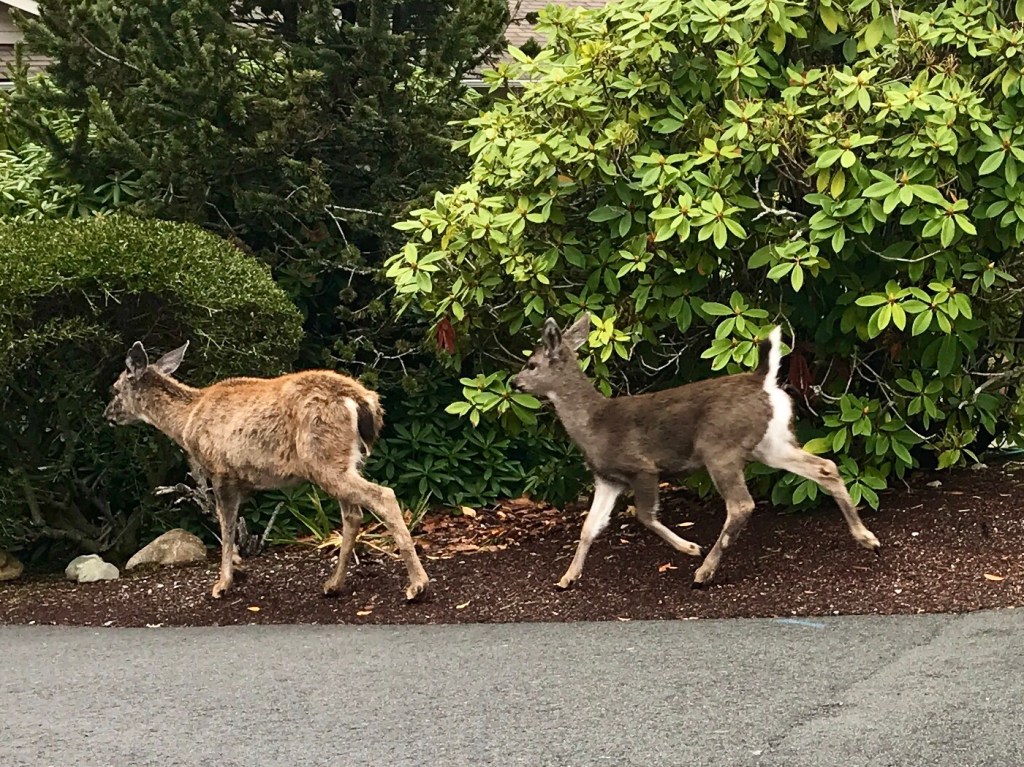
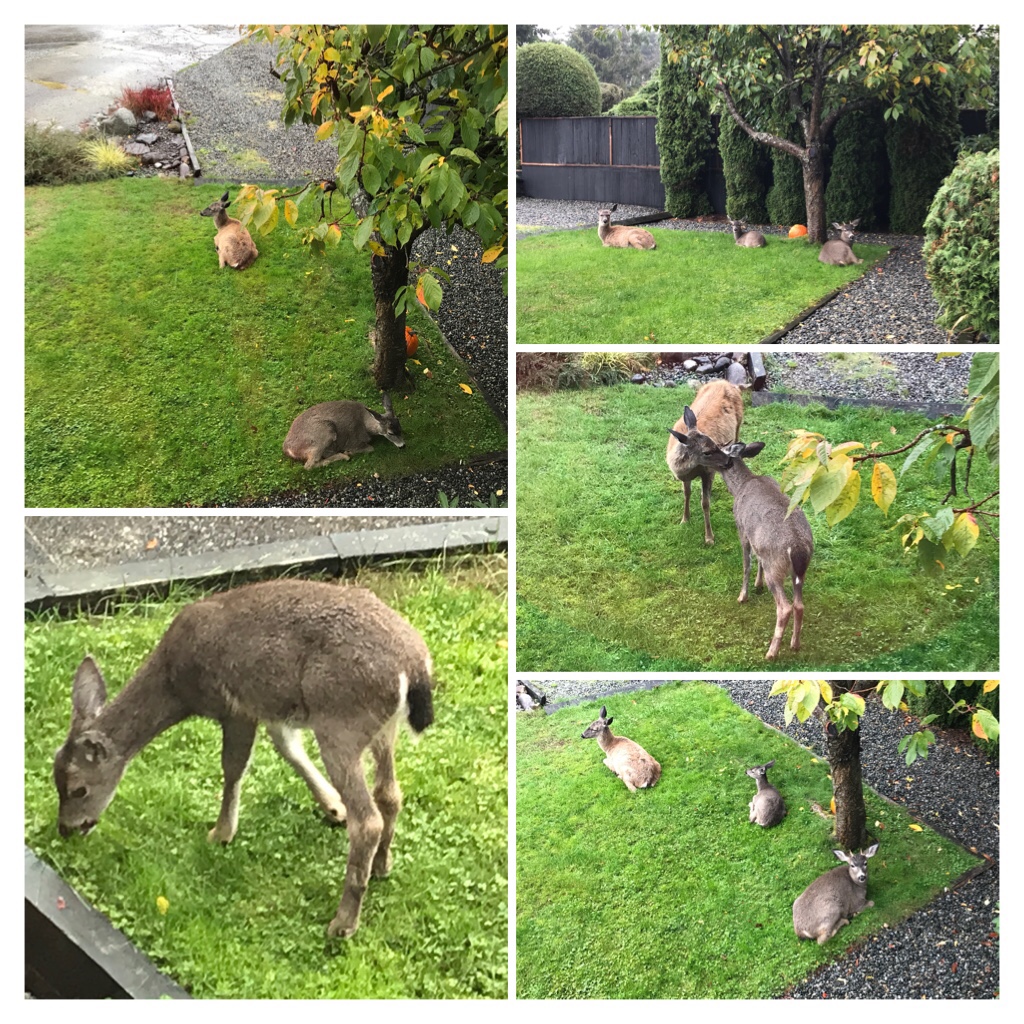
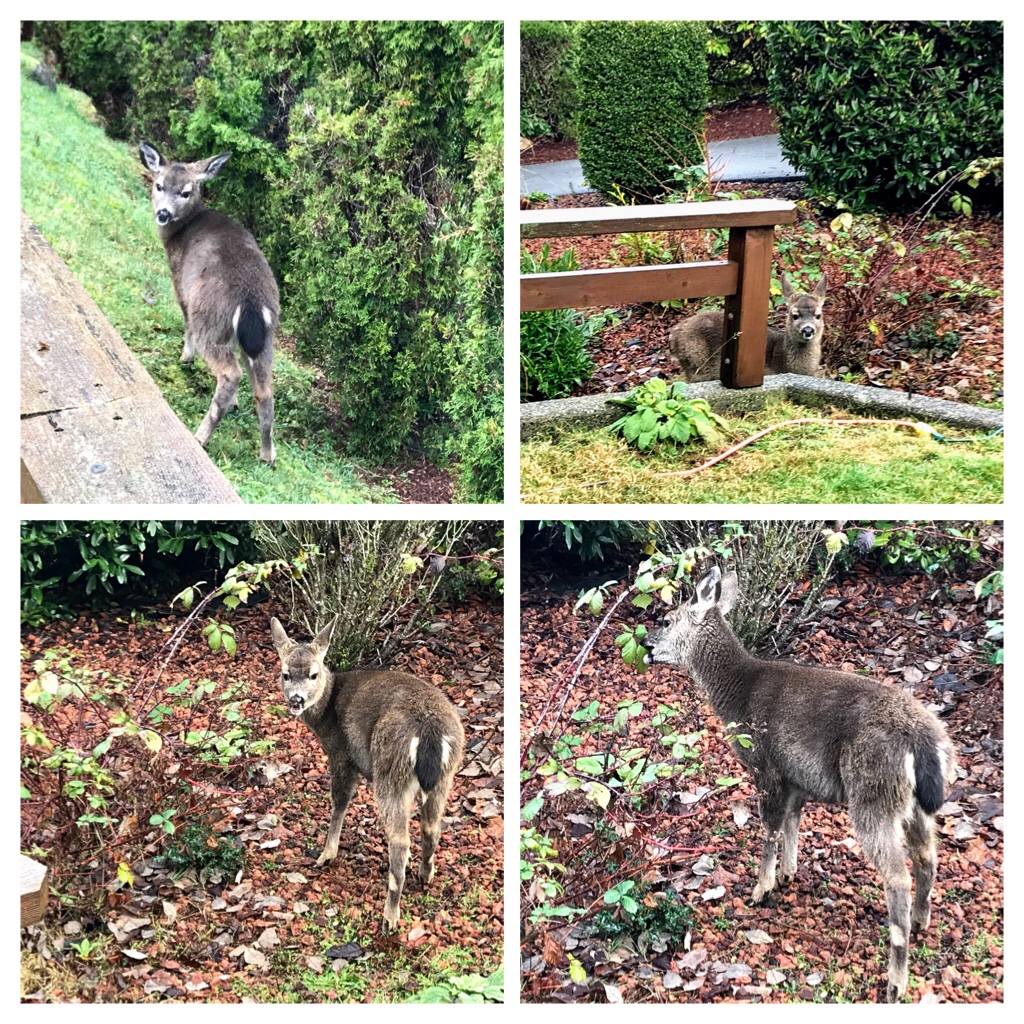
On Vancouver Island, according to the B.C. Ministry of Environment, Conservation and Parks there are 150,000 to 250,000 Columbian Black-tailed deer. These deer are identified by their large mule-like ears, a white rump and an all-black tail.
Black-Tailed Deer
The population of Columbian Black-tailed deer (subspecies of the mule deer) fluctuates based on a variety of reasons. This Discover Vancouver Island website contains interesting facts about Black-Tailed Deer from general habits and mating, to their life cycle and food choices. https://www.discovervancouverisland.com/wildlife-on-vancouver-island/black-tailed-deer/
An informal consensus with friends typically divides people’s opinions on our Black-Tailed Deer population into 3 categories: hunters (fresh wild venison), gardeners (annoyed by the foliage consumed by deer), and nature lovers (adore watching the deer and encourage their presence).
Sophia (our cat) watching the Deer family grazing in the front yard.
I must confess, our household has evolved into a combination of the 3 categories. Although we do not hunt, a gift of lean wild venison is a delicacy we greatly appreciate.
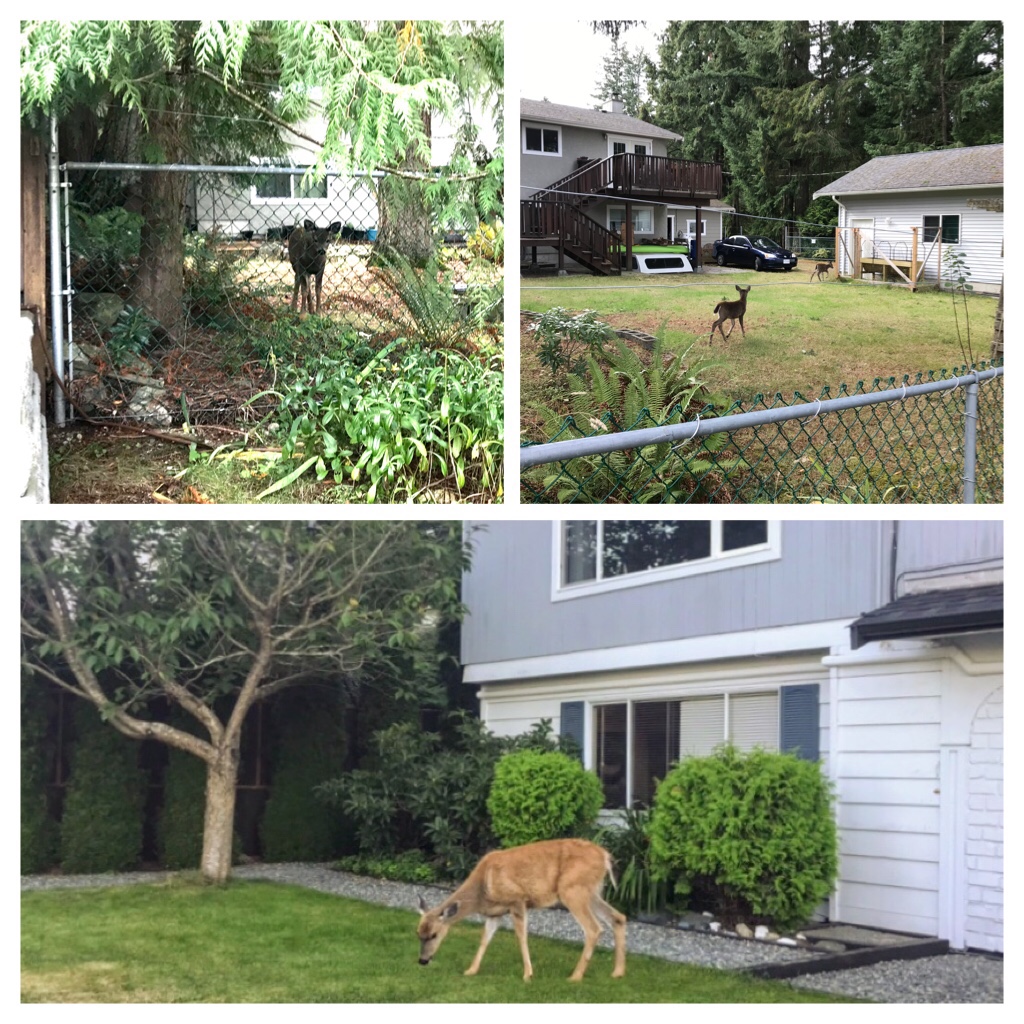
Fenced backyard… open to graze in the front yard
Our backyard is fully fenced in order to keep the deer out. They quickly consume fresh veggies, flowers, and new growth on plants. However, our front yard is free territory for deer to graze and wander or relax.
As the seasons rotate, we find ourselves curious about the upcoming new fawns and look forward to observing the deer family behaviors and interactions.
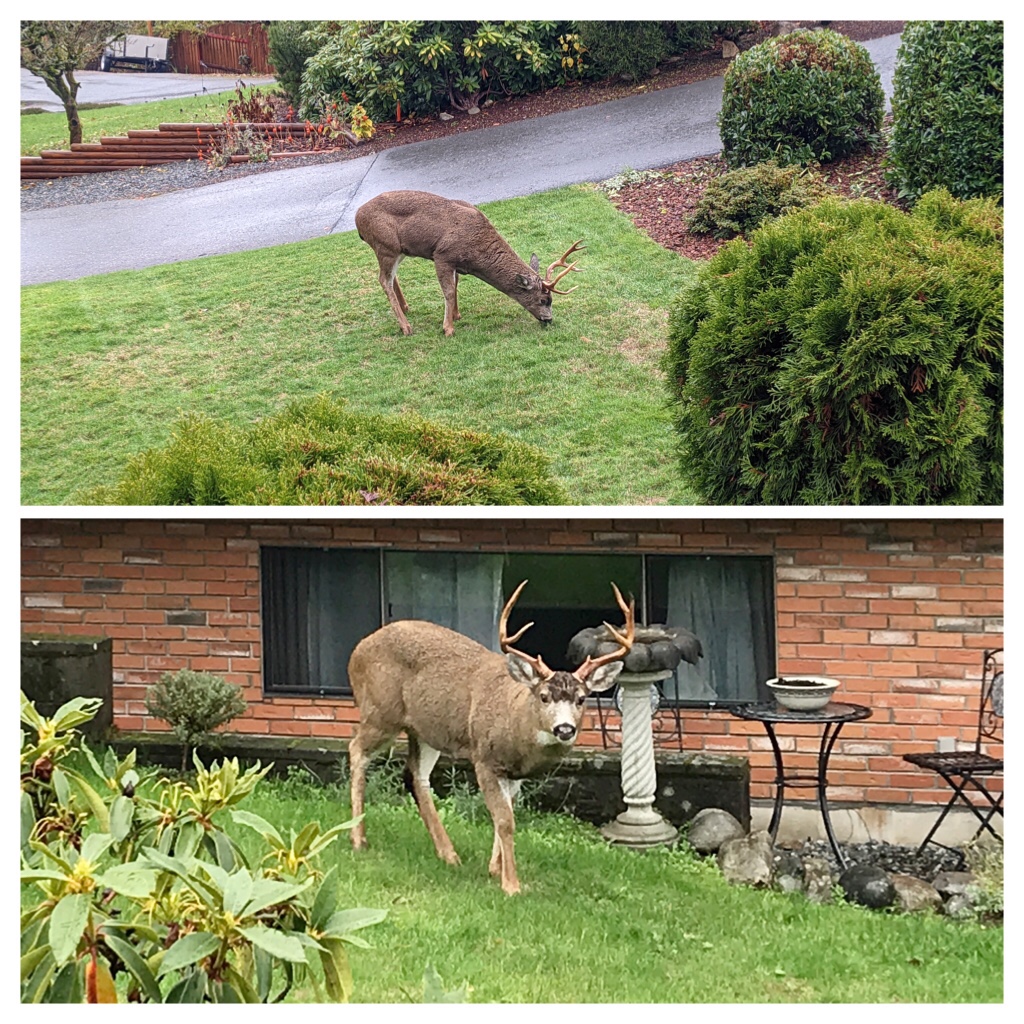
Rutting/mating Season! This big buck suddenly started showing up and chasing the does!
At present… It isNovember (AutumninCanada). To our Black-Tailed deer this means it is rutting/mating season! We can hear the Bucks (males) crashing their antlers together as they fight to establish dominance!
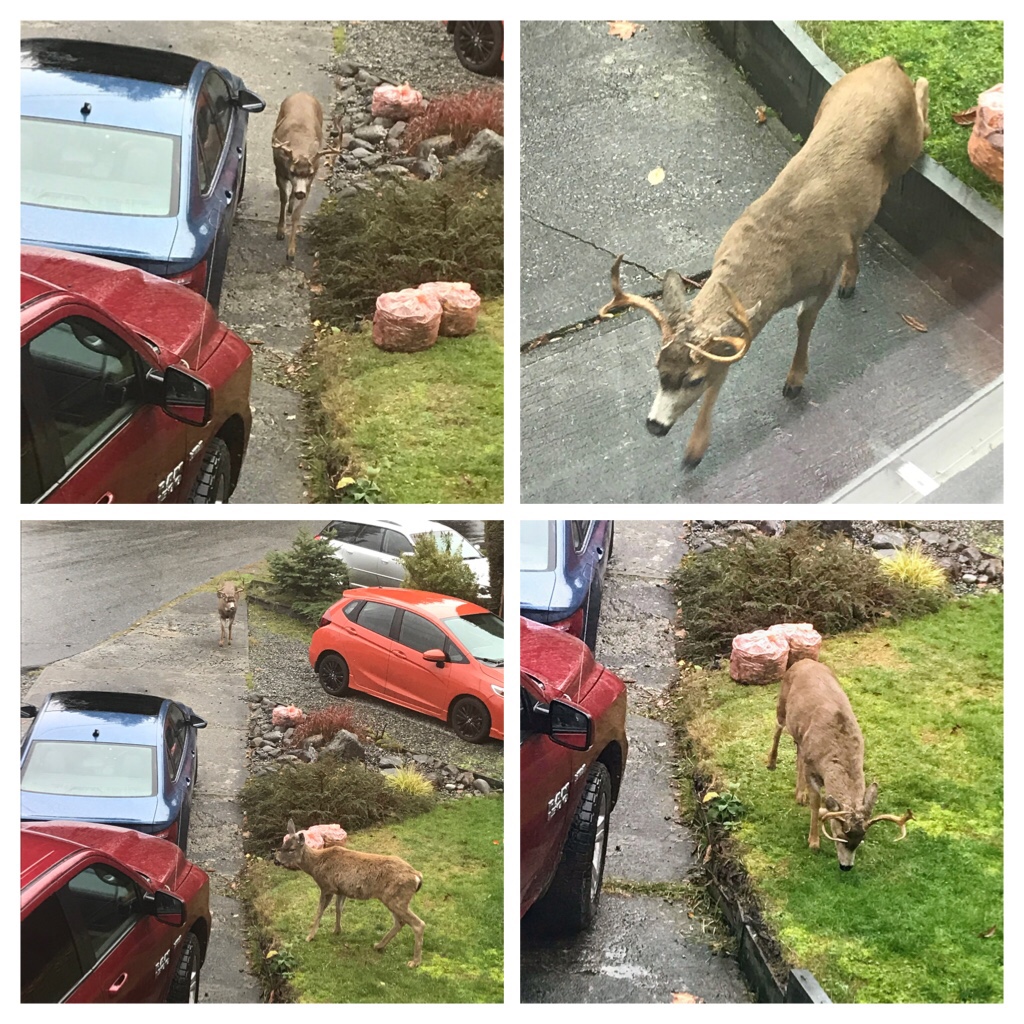
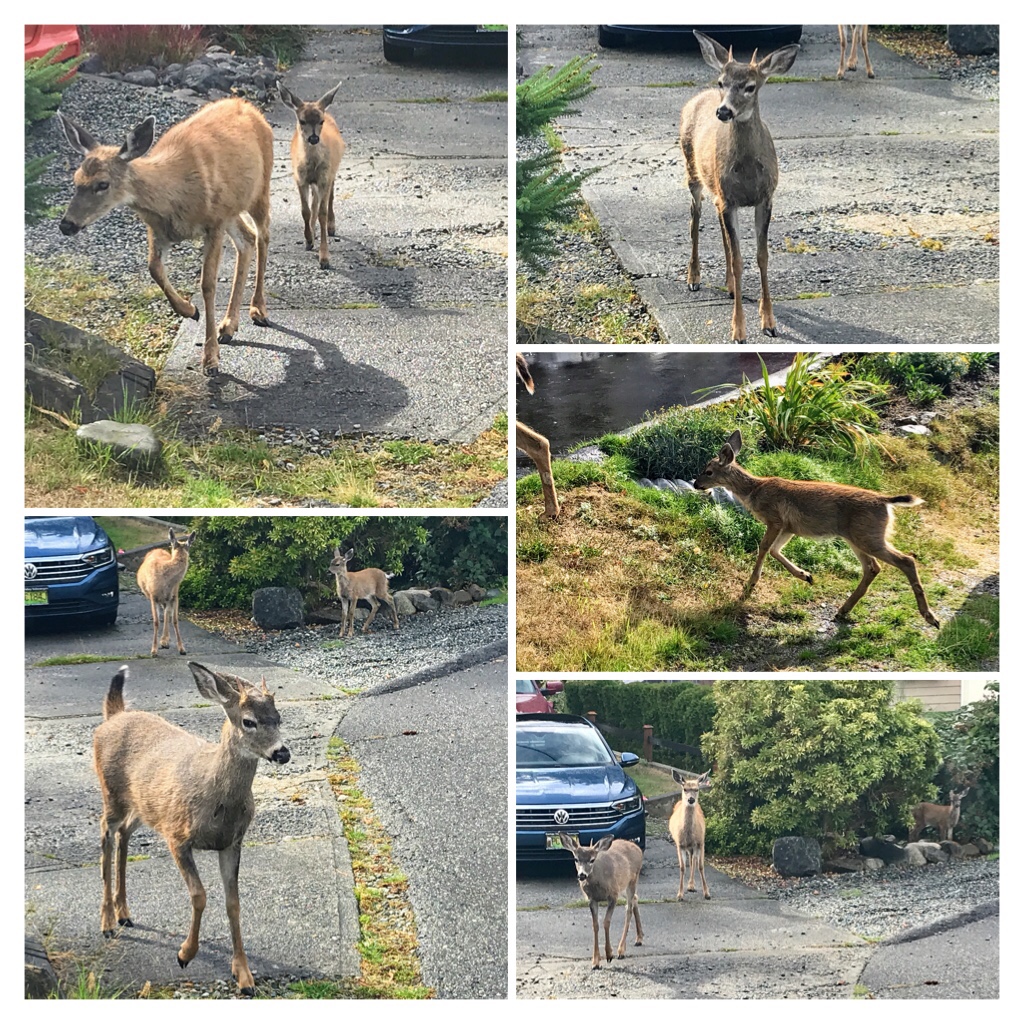
Another big buck recently appeared… The doe started running away when she saw him heading her direction–right beside our vehicles!
We observe the Does (females) pushing away their 1 1/2 year old sons. It’s time to leave mom’s company and become independent. The does will be in heat soon and inbreeding is not encouraged!
This was a family unit that frequented our yard until this past month. Momma doe is now being chased by big bucks. This year’s fawn remains with her. Last year’s fawn (buck) now has spike antlers and momma has chased him off to be independent.
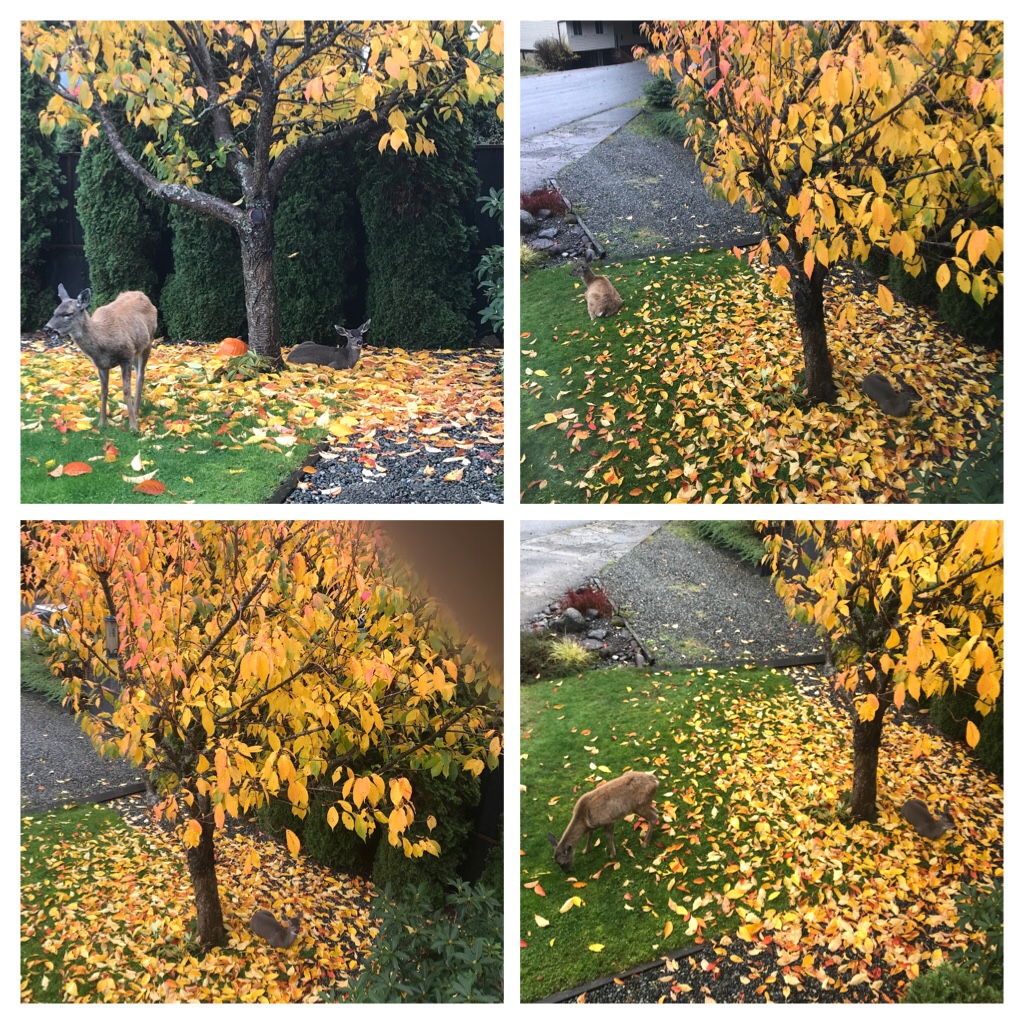
By late October … Spike was not included when momma doe and this year’s fawn wandered through our yard to munch on newly fallen leaves and grass. The fawn seemed to enjoy resting on top of the autumn leaves.
Late October…. Spike was no longer part of the family unit.
Dominant bucks suddenly appear during daylight hours to mate and chase does. The bucks remain by the doe’s side for several days while she is in heat.
Bucks remaining by doe’s side during her estrus period.
Reflecting back to September andOctober, the deer family units were still intact in our neighborhood. Momma doe had been injured on her back leg and she continues to lick the wound regularly and struggle to walk. This year’s fawn is usually close beside her and rarely wanders out of her sight. Last year’s fawn has grown into a healthy young buck and is now sprouting spikes on his forehead!
Our usual deer family—including Spike!
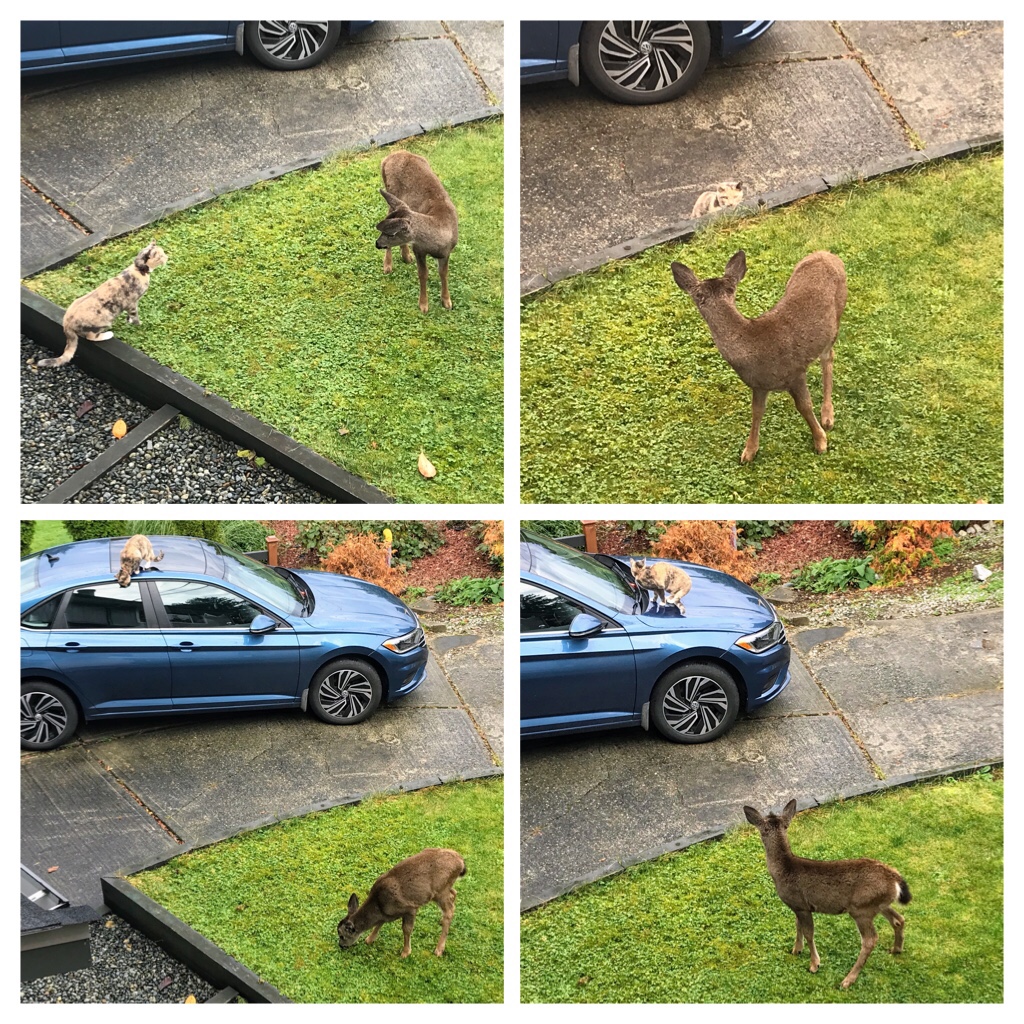
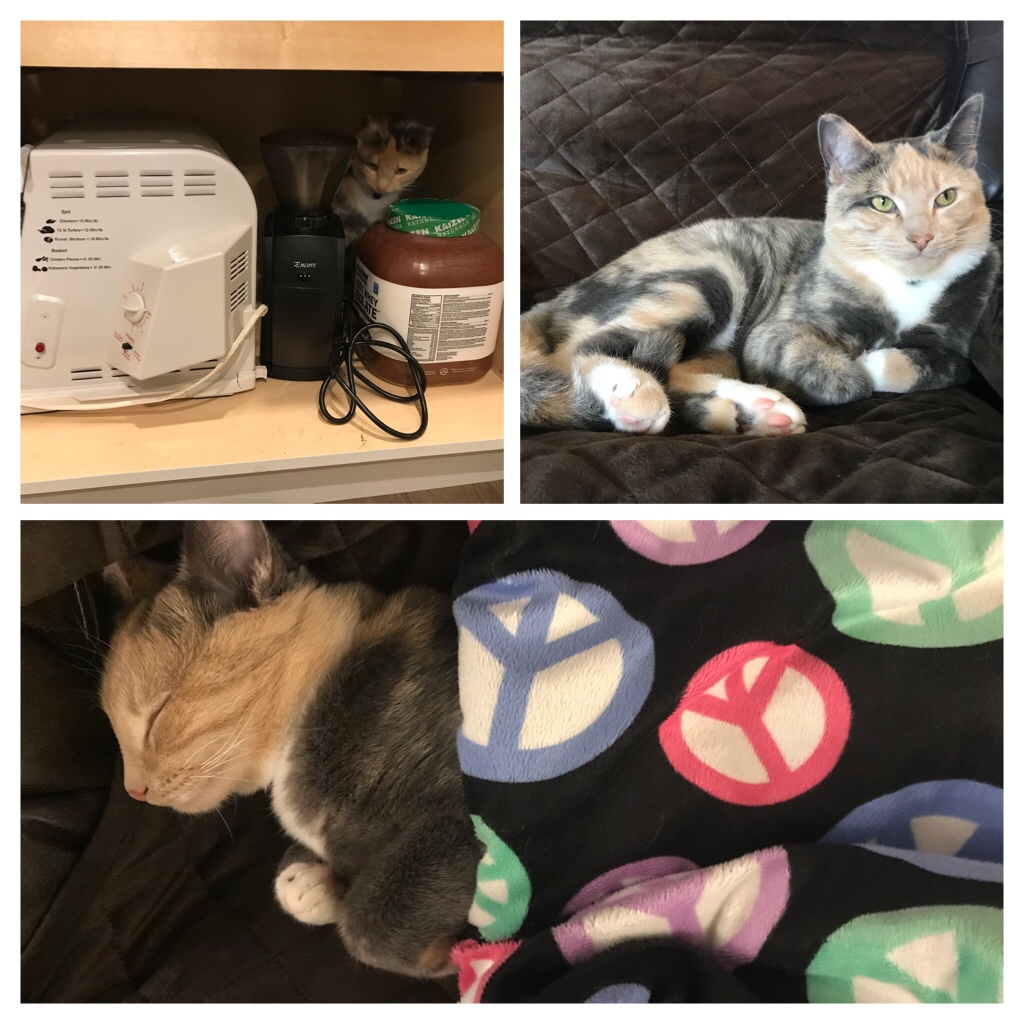
Our cat, Sophia, continues to be fascinated by the deer family–mainly the youngest fawn. They watch each other from a distance, and naughty Sophia even sits on the roof of the vehicles to increase her safety and view.
Sophia and the fawn playing in our yard.
Sophia watching the action from a distance!
Sophia and the fawn! October 2021
Once a doe falls pregnant, the gestation period is nearly 7 months long.
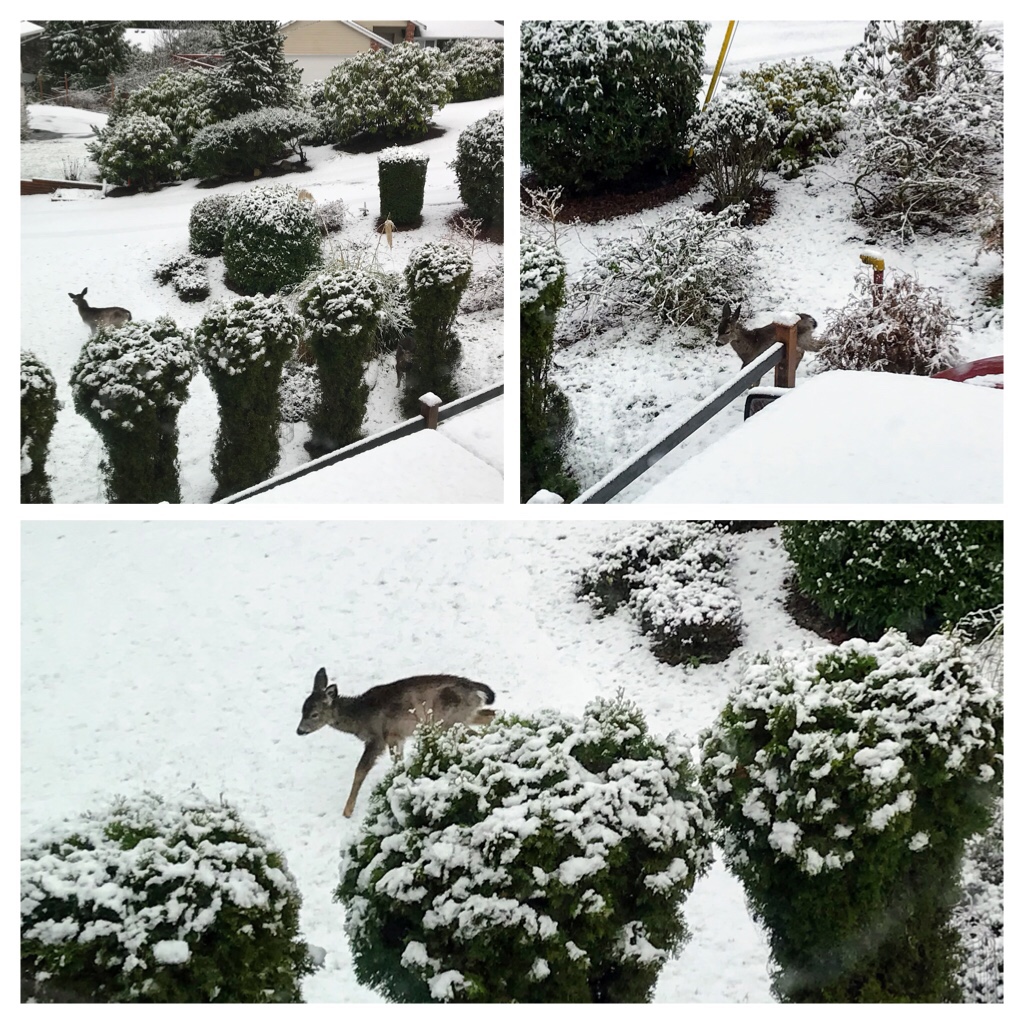
We don’t see our urban deer as often during the winter months
During the winter the deer cope with the colder temperatures by hiding under foliage and growing thick coats.
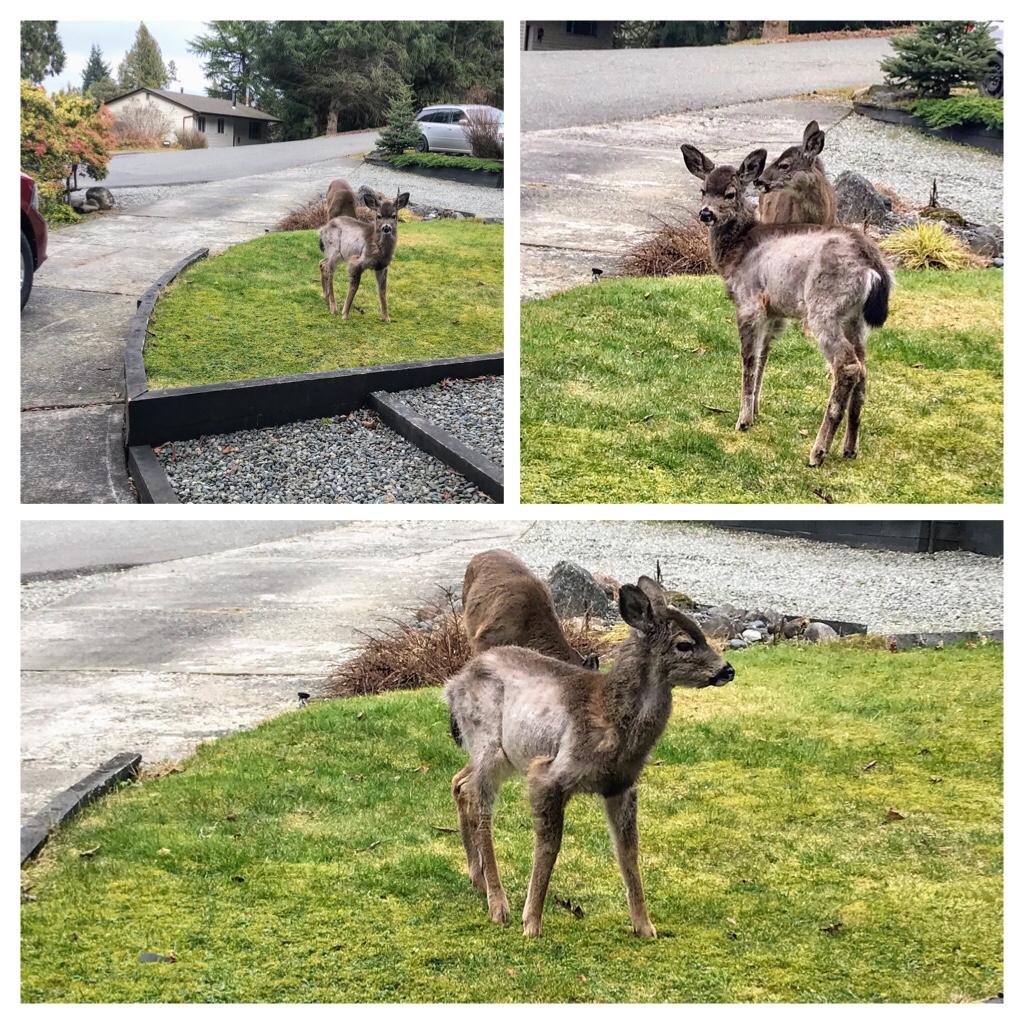
Momma and last season’s twins
Last March a momma doe and her twin fawns popped by to graze in our yard.
The deer are in the process of shedding their thick winter coats! (March)
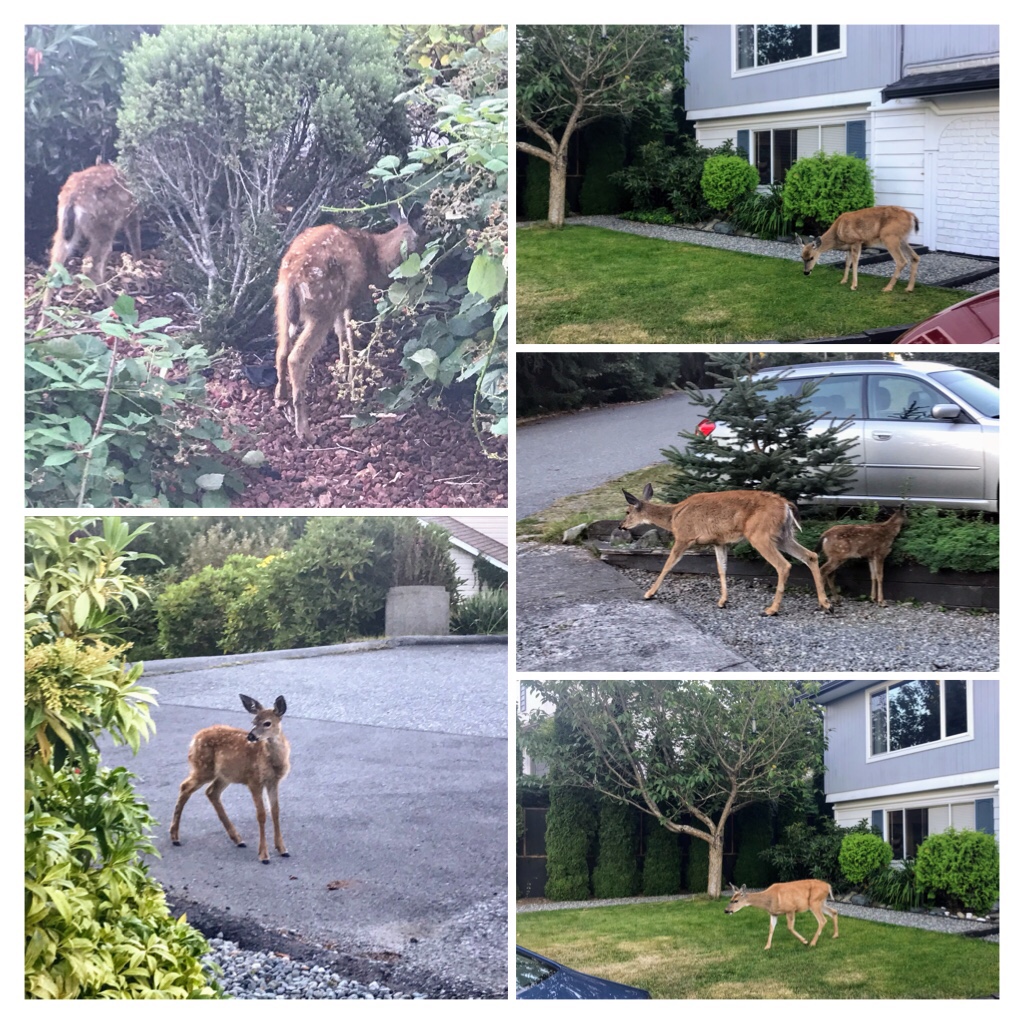
The majority of fawns are born during May/June in our area. Twins are common, but young does sometimes only produce one fawn.
The new spotted fawns finally venture out to visit! Summer
On Vancouver Island, the major predators for black-tailed deer are: humans, wolves, cougars, and occasionally Black or Grizzly bears. Lynxes and wolverines are additional threats on the coastal mainland of British Columbia, but do not exist on Vancouver Island.
A new threat is making the news in the past year. AHD (Adenovirus Hemorrhagic Disease), is a contagious virus killing black-tailed deer on Vancouver Island and the surrounding Gulf Islands in B.C.
Apparently, the disease is only found in deer populations and spreads mainly through nose-to-nose contact. Information is accumulating about AHD on many veterinarian and hunting websites.
Dedicated to our neighbourhood Pacific Northwest Black-tailed deer.
We are entranced by our urban black-tailed deer families and look forward to observing visits each day. Keep safe and keep healthy my cervidae friends. Winter is coming!
Upcoming posts will be about antics of Sophia and more hiking adventures on Vancouver Island.
One of the many joys of living on Vancouver Island, B.C. is that nearly all communities are near, or adjacent to, the beautiful Pacific Ocean.
Living in Nanaimo (population over 100,000), there are so many diverse ways to explore nature and the outdoors. This blog post focuses on one of the favorite kayaking areas to explore in Nanaimo. Newcastle Island, is also known as Saysutshun by the local Snuneymuxw people.
Let’s explore Newcastle Island!
The following excellent website thoroughly explores Newcastle Island (Saysutshun) from Ferry Schedules, to Camping, Moorage, Maps of Trails, and Explanation about the Culture and History of the Marine Provincial Park. http://newcastleisland.ca
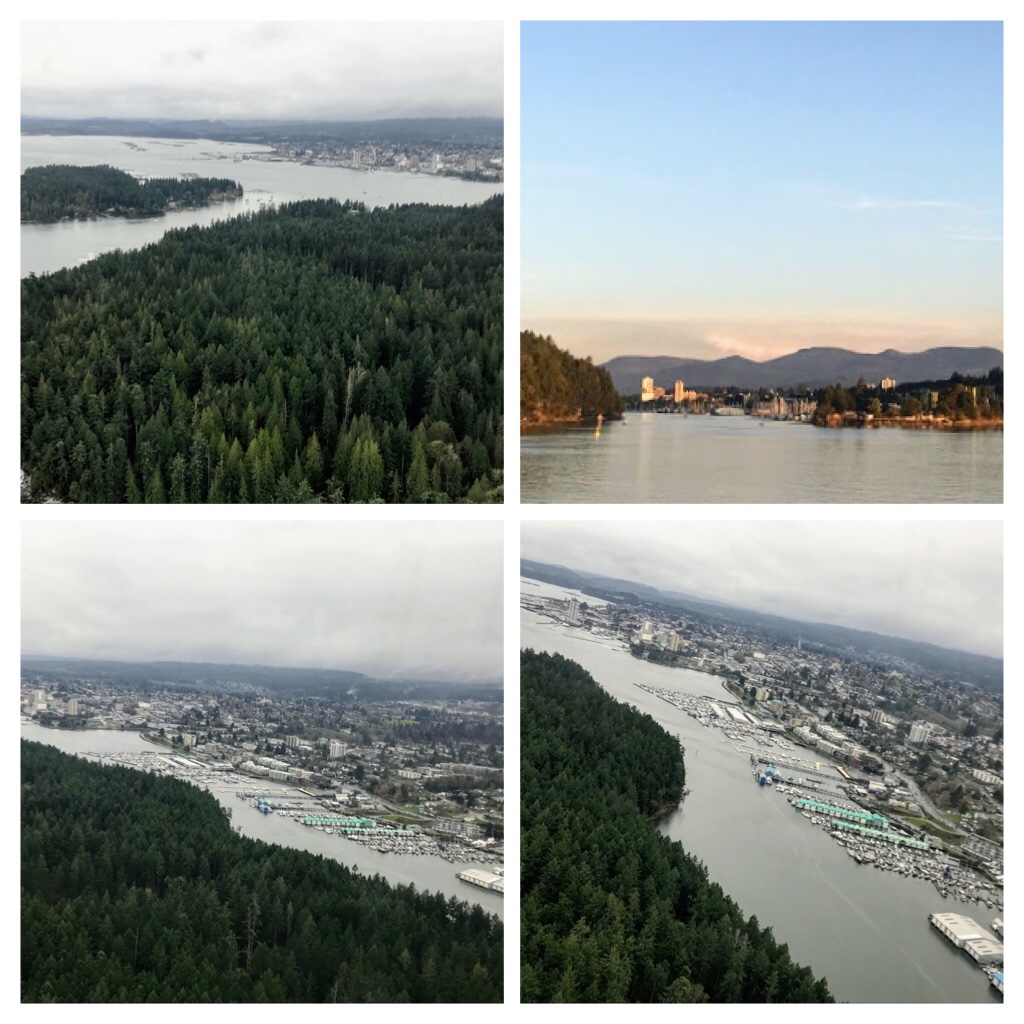
Newcastle Island is less than a kilometer’s paddle across the water from several launching locations in Nanaimo. It is about 8.5 km to circumnavigate the island by water. These aerial views of Newcastle and Protection Island were taken from a float plane while flying in/out of the Nanaimo harbour.
Nanaimo harbour and nearby islands. Views from float plane.
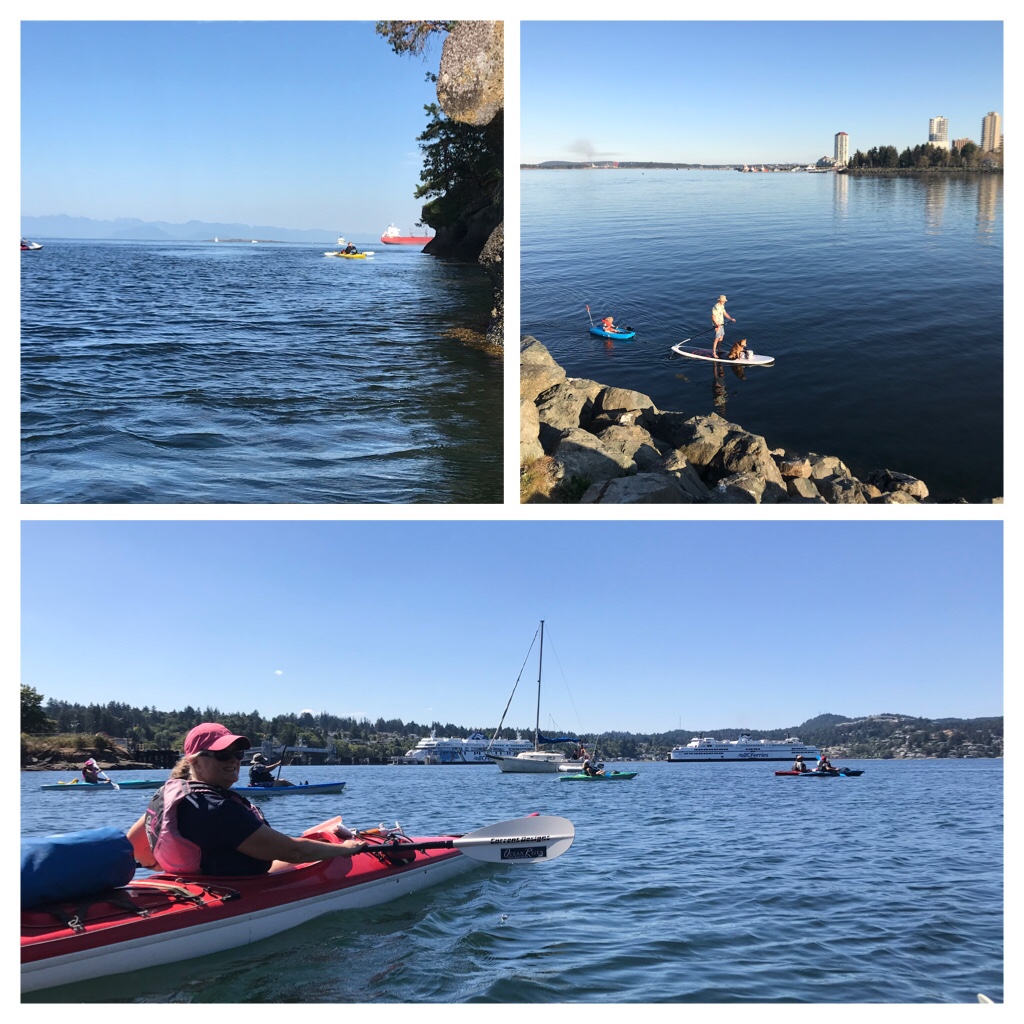
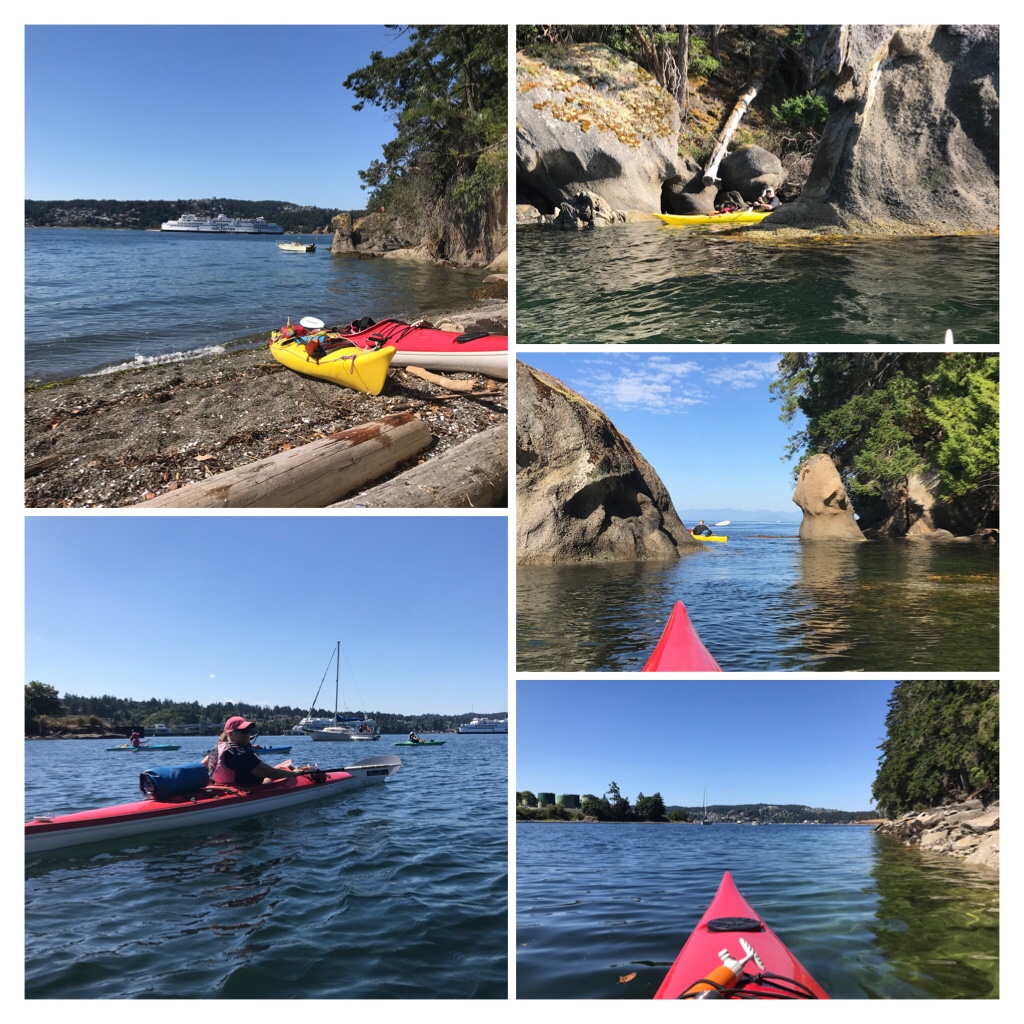
Newcastle and Protection Islands are popular locations, so expect to see other kayaks, sailboats, pleasure craft, even B.C. Ferries sharing the water with you!
Sharing the water around Newcastle Island, Nanaimo.
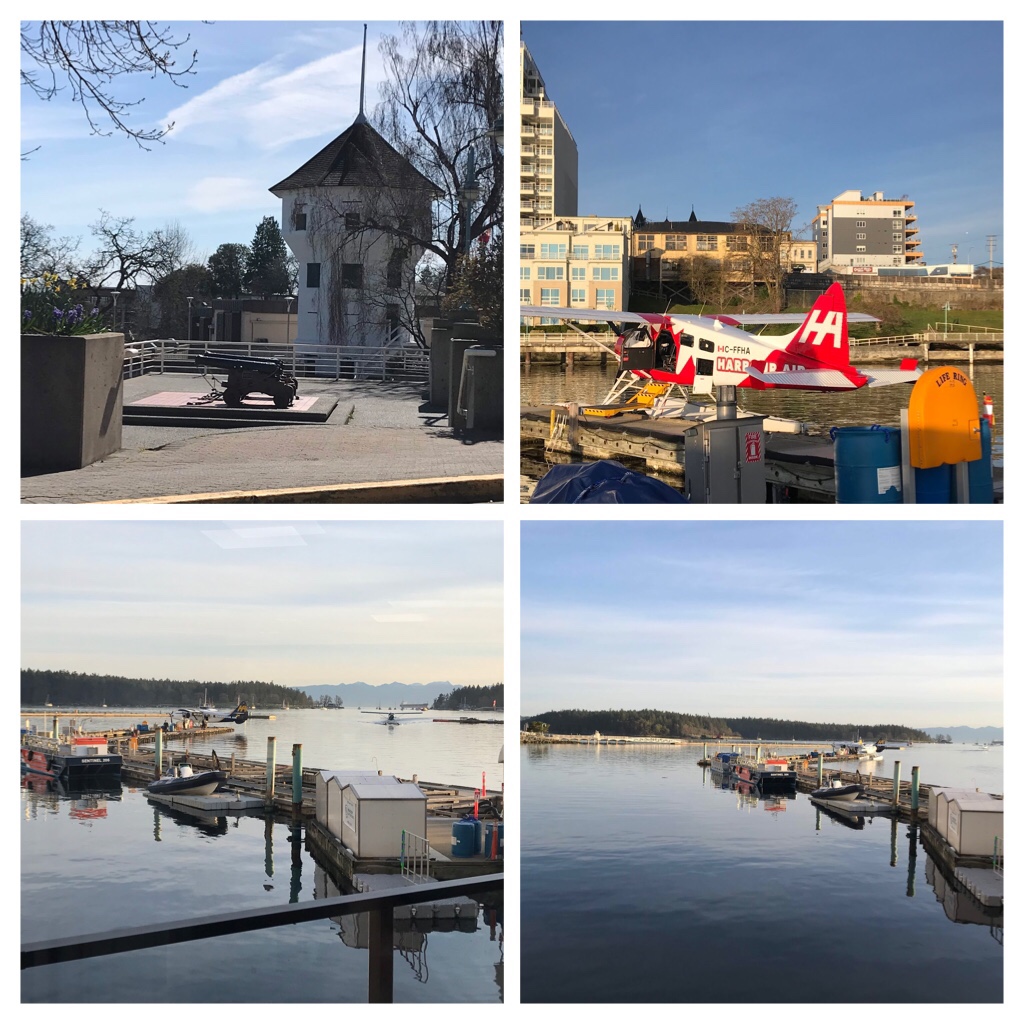
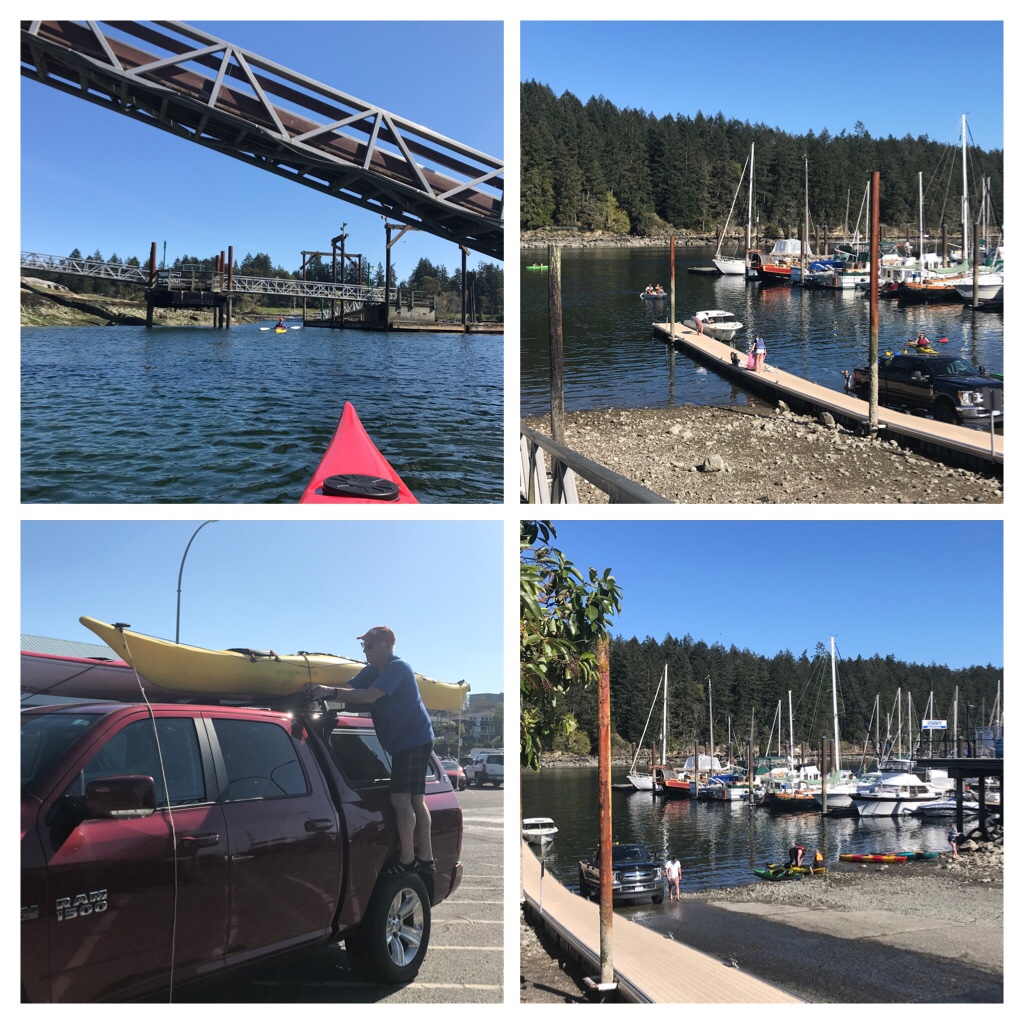
There are several FREE locations available to launch your kayaks. The size of your kayaks and ease of parking influences your selection. Some locations have free parking. Other locations require pay parking. You can launch from the following locations: Nanaimo Harbour Marina (downtown);
Downtown harbour
Maffeo Sutton Park has access for smaller kayaks to launch;
Maffeo Sutton Seawalk
More launching sites include: Brechin boat ramp; Queen Elizabeth Promenade (near the Yacht Club); Departure Bay Beach; and Stephenson Point.
We own touring ocean kayaks which are longer than most day trip recreational kayaks.
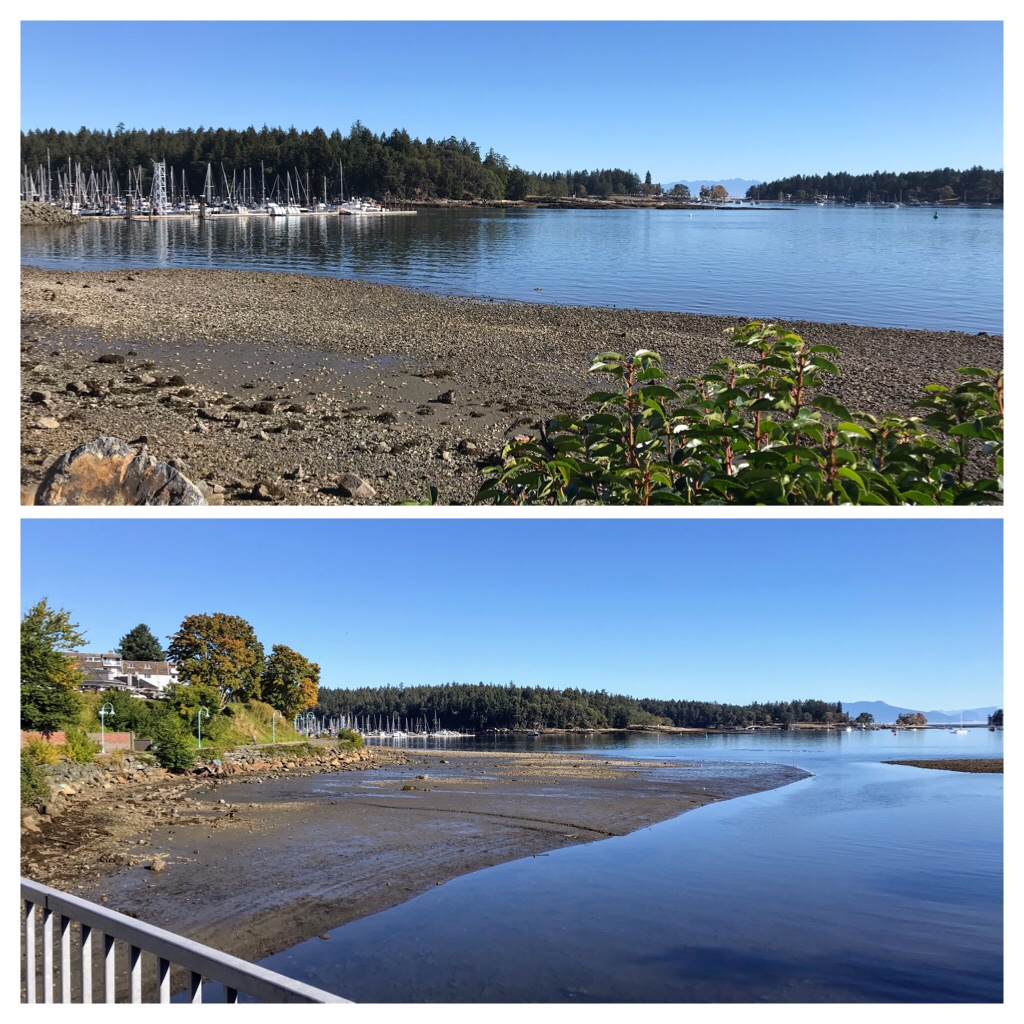
Brechin Boat Ramp. Newcastle Island in the Background.
Our boats are very seaworthy, designed for multi day trips with 2 hatches, but are over 16 feet in length! Our usual launching location is Brechin Boat Ramp.
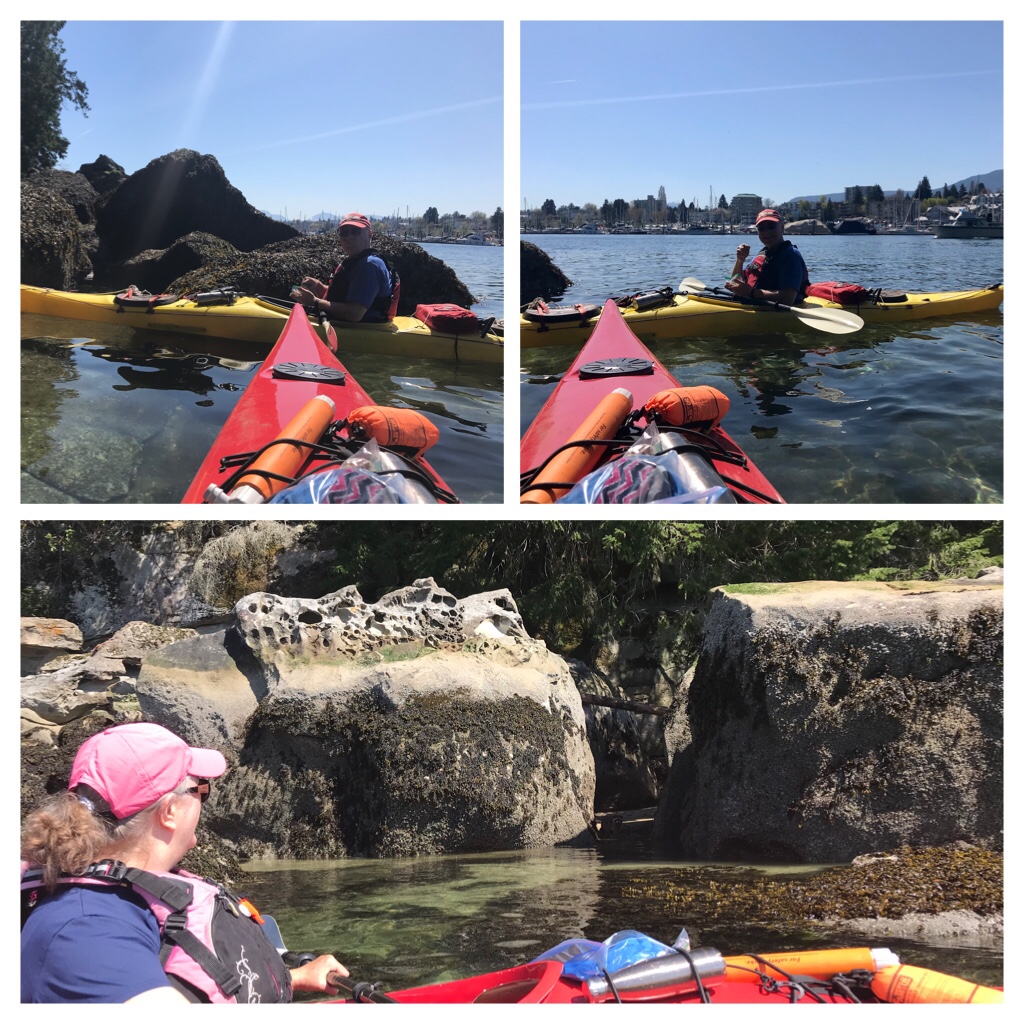
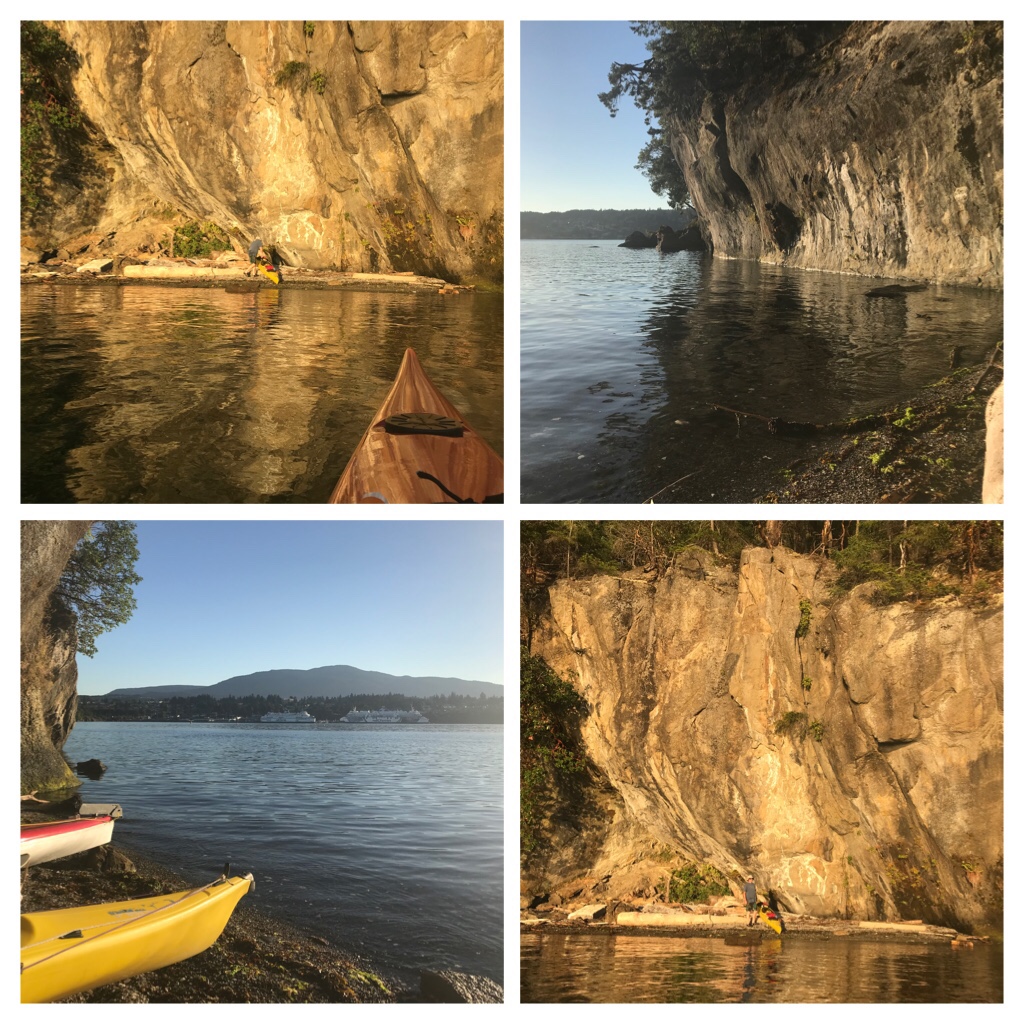
Let’s get kayaking! The following kayak adventure photos were taken during 3 different adventures while kayaking around Newcastle (Saysutshun) Island. One trip occurred during April (Spring), the other 2 trips occurred during August (summer).
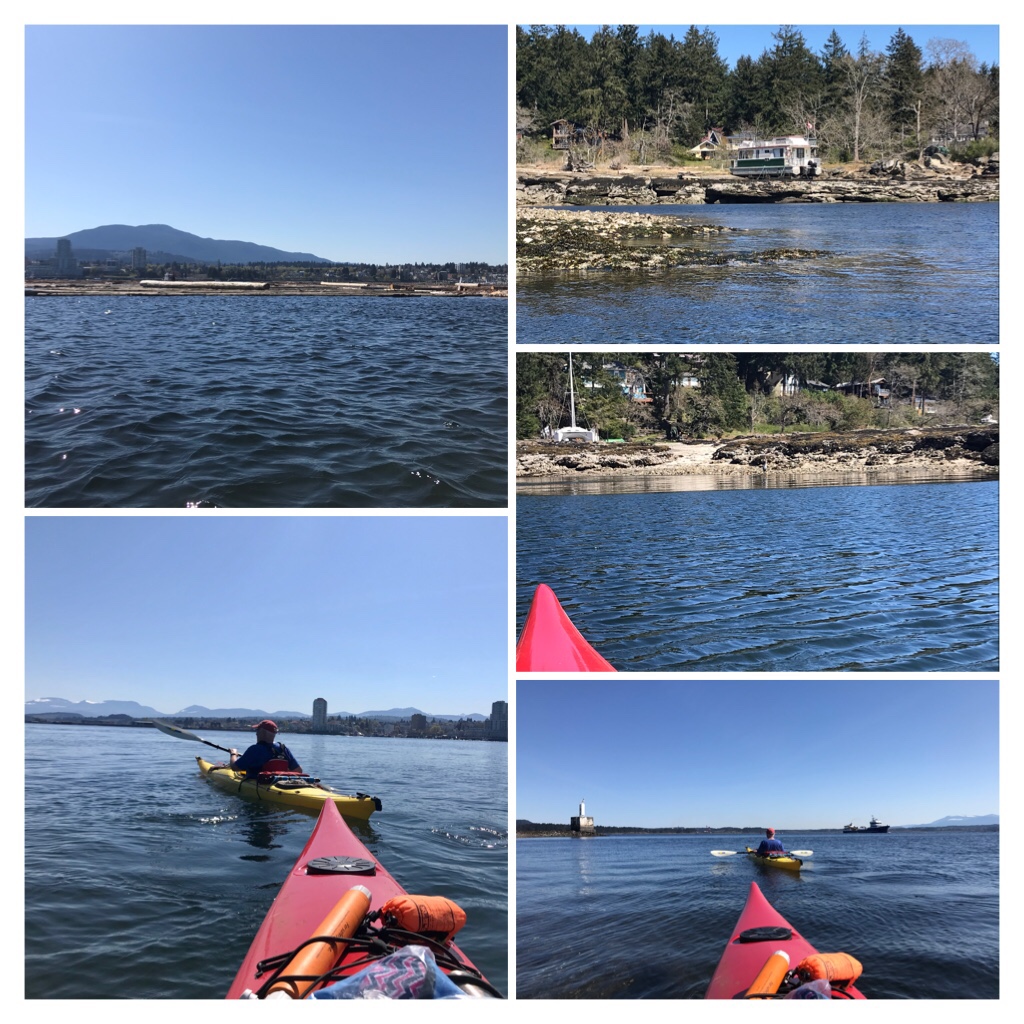
April: Needing to take a break from Covid masks and restrictions? Kayaking on a sunny day in Spring is such a pleasant remedy to any feelings of confinement. We departed from Brechin boat ramp and headed along Newcastle, toward downtown Nanaimo, then continued across the water to Protection Island.
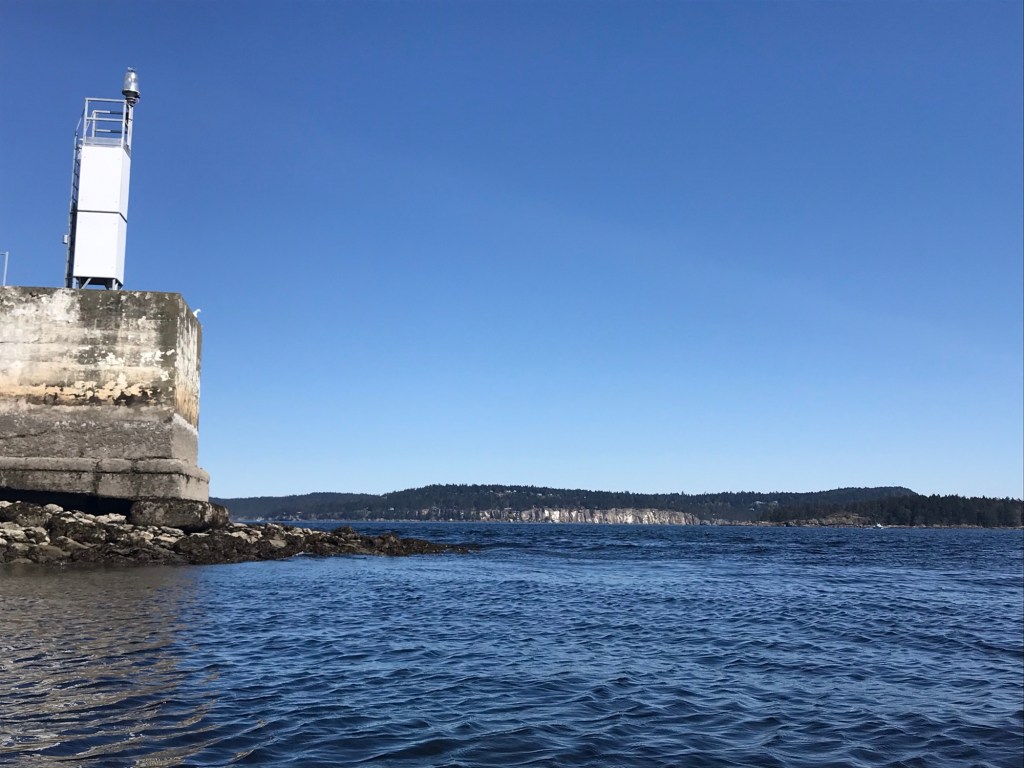
My husband and I paddled past a log sort boom and continued towards a beacon. From this location, there is a fabulous view of the cliffs on Gabriola Island.
Beacon. The cliffs of Gabriola Island in the background.
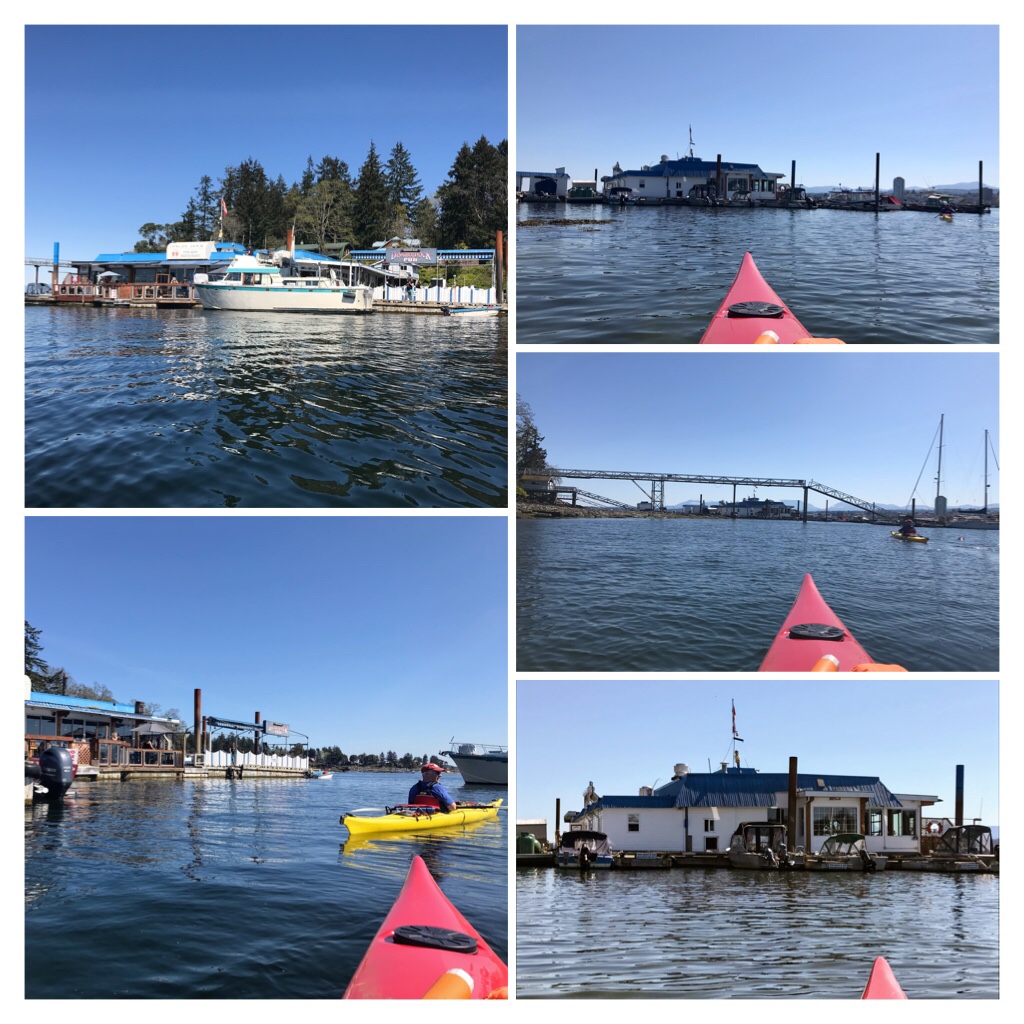
Dingy Dock floating pub was open with limited capacity due to Covid. A pleasure craft arrived before we could maneuver our kayaks to the back dock, so there was no space in the floating pub for us today!
Dingy Dock Pub on Protection Island.
Returning to Newcastle Island, we explored the spit area adjacent to the park picnic area.
Newcastle Island
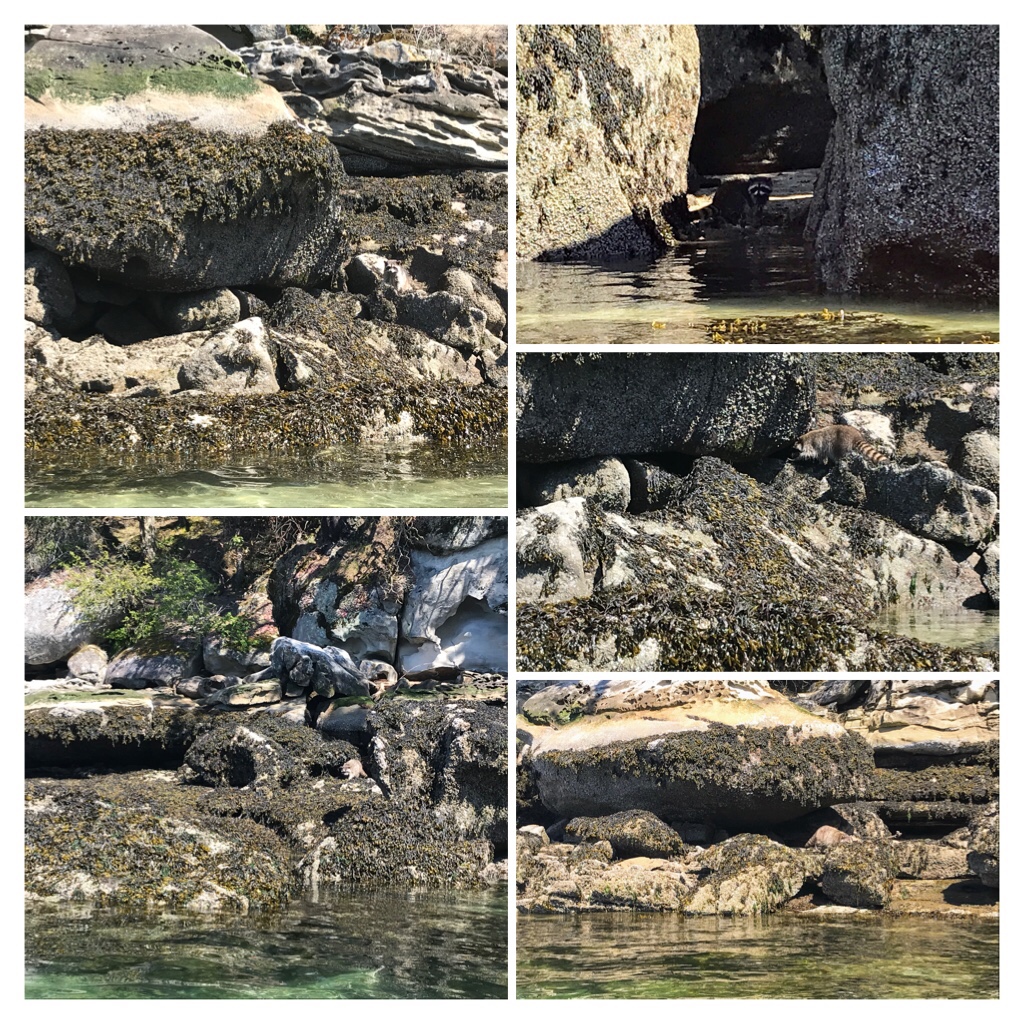
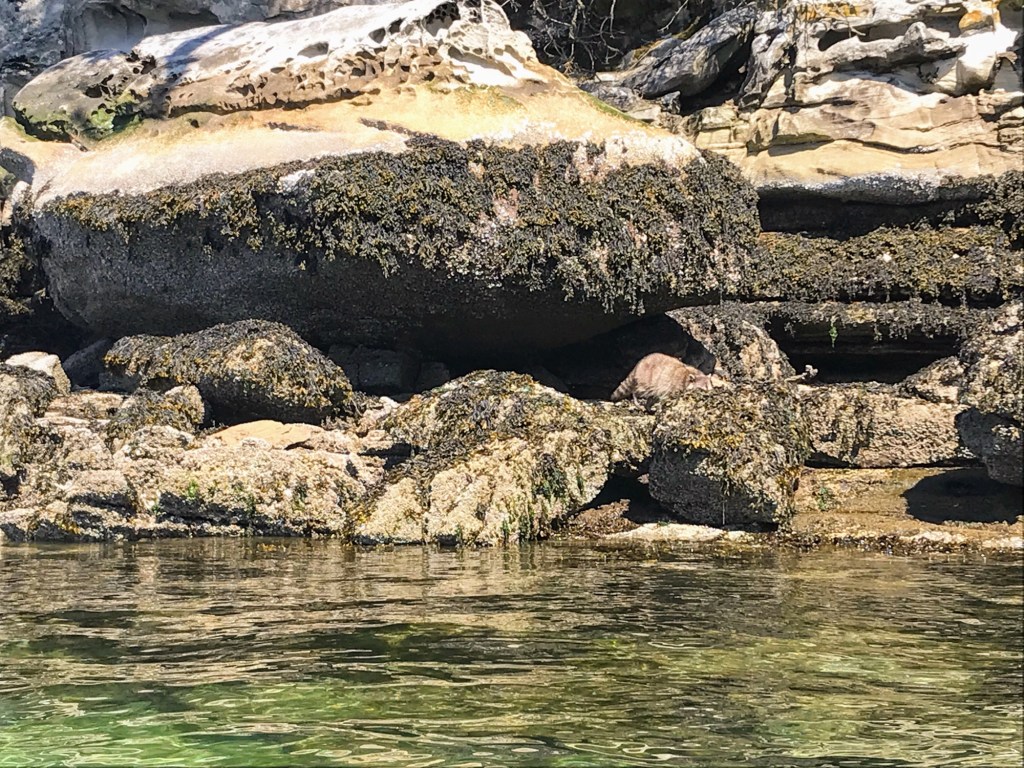
As we continued to explore the craggy notches between the island and the water, we observed a few raccoons feasting on low tidal delicacies.
Can you locate the albino raccoon in each photo?
It is common to observe raccoons on Newcastle Island, but today we glimpsed a couple of the more rare, albino raccoons.
Albino raccoon scavenging along the tidal rocks at Newcastle.
Time to head back…
It was a beautiful day to explore!
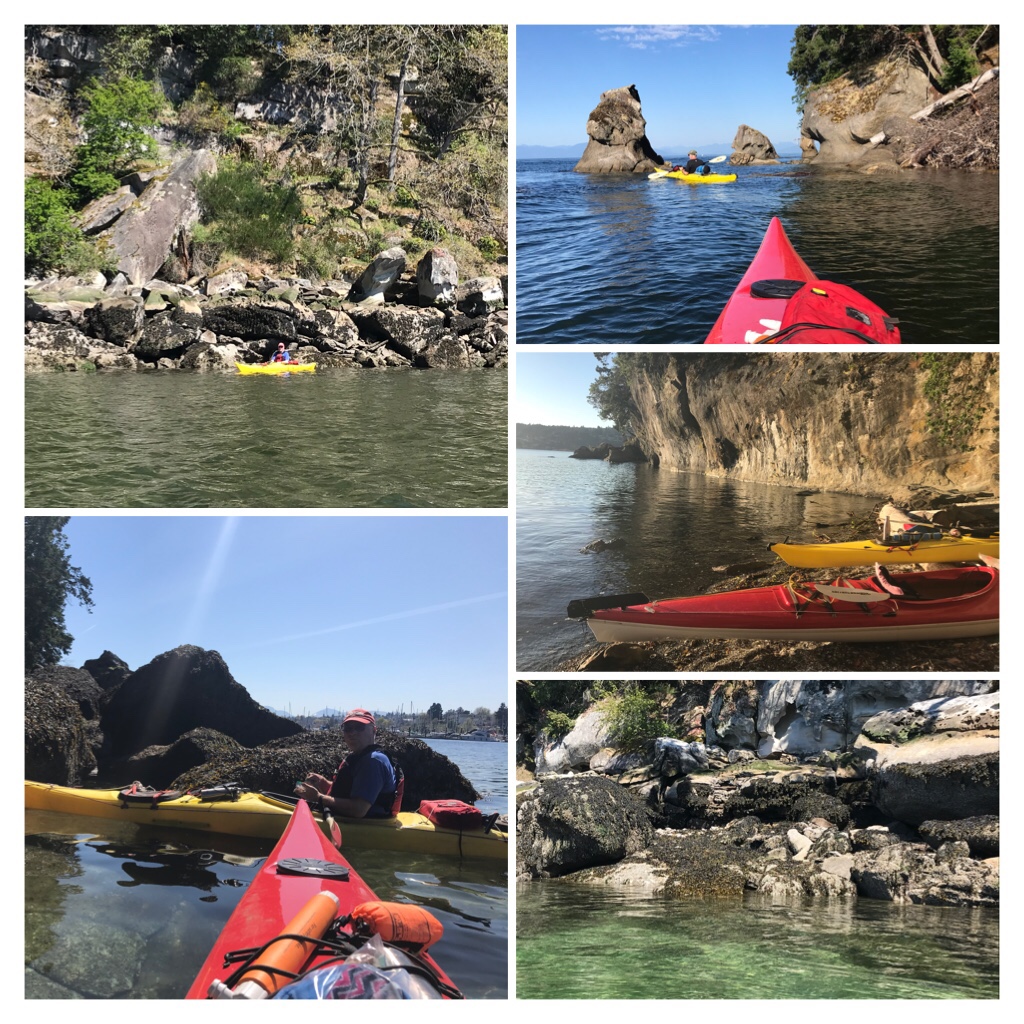
Summer (August) kayak highlights from our paddle circumnavigatingNewcastle Island.
Circumnavigating Newcastle.
The 8.5 km trip around Saysutshun is lovely and there are many gorgeous hidden gems to discover. Expect a few larger waves when you round the corner and head towards the more open strait on the outside of the island.
Here is a video highlighting our kayak adventure around Newcastle island in mid August.
The sunny weather and beauty of this location drew us back for an additional kayak the very next day! This time we went out for an evening kayak and swim in the ocean at Newcastle.
Mark waves hi as he swims. Cozy spot to rest the kayaks.
August Kayak adventures and swimming at Newcastle…Part 2. The evening sunset glows were magical.
Evening kayak and relaxation around Newcastle. Such a gem!
No wonder Newcastle Island is such a popular kayaking destination in Nanaimo. Meanwhile…Switching sports, I have hikingadventures around Nanaimo to blog about next. Keep Safe and Keep Smiling! S
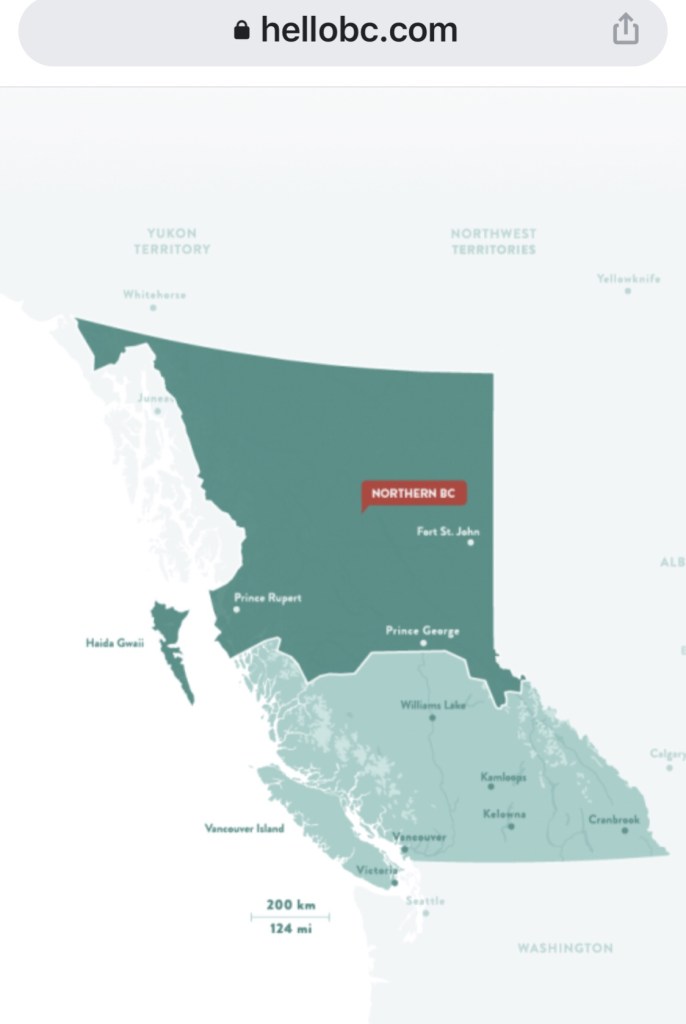
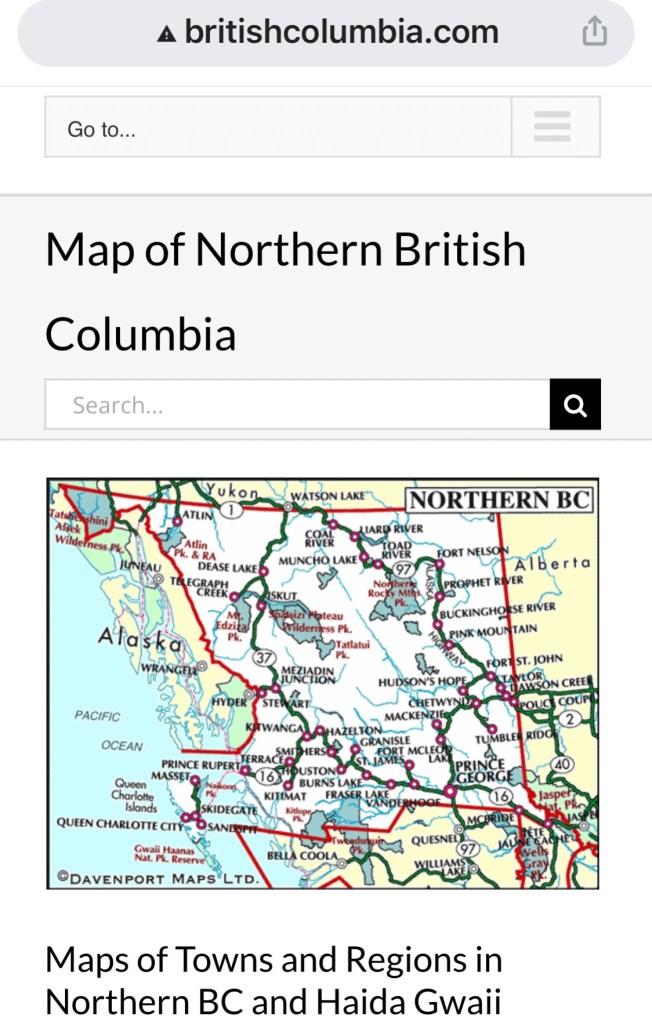
Northern British Columbia is larger than California and extends from Haida Gwaii and Prince Rupert on the west coast east along highway16 through Stunning Smithers and Nechako Lakes District to Prince George. Northern B.C. area continues north defined by the B.C./Alberta provincial border extending up to the Yukon/Alaska border!
The dark green is massive Northern British Columbia, Canada
It truly is a massive area to explore. This blog post will focus on the towns of Smithers, east along highway 16 to Burns Lake in Nechako Lakes District, and ending in the city of Prince George.
This blog post will start at Smithers and end at Prince George, B.C.
Smithers is a cozy community which has maintained a steady population of around 5,500 people over the past decade. The town is located about one-half way between Prince Rupert and Prince George on Highway 16. The total estimated distance driving from Prince Rupert straight through to Prince George is about 8 hours (719 km) providing there are no stops for road work, moose, snow plow clearing, etc.
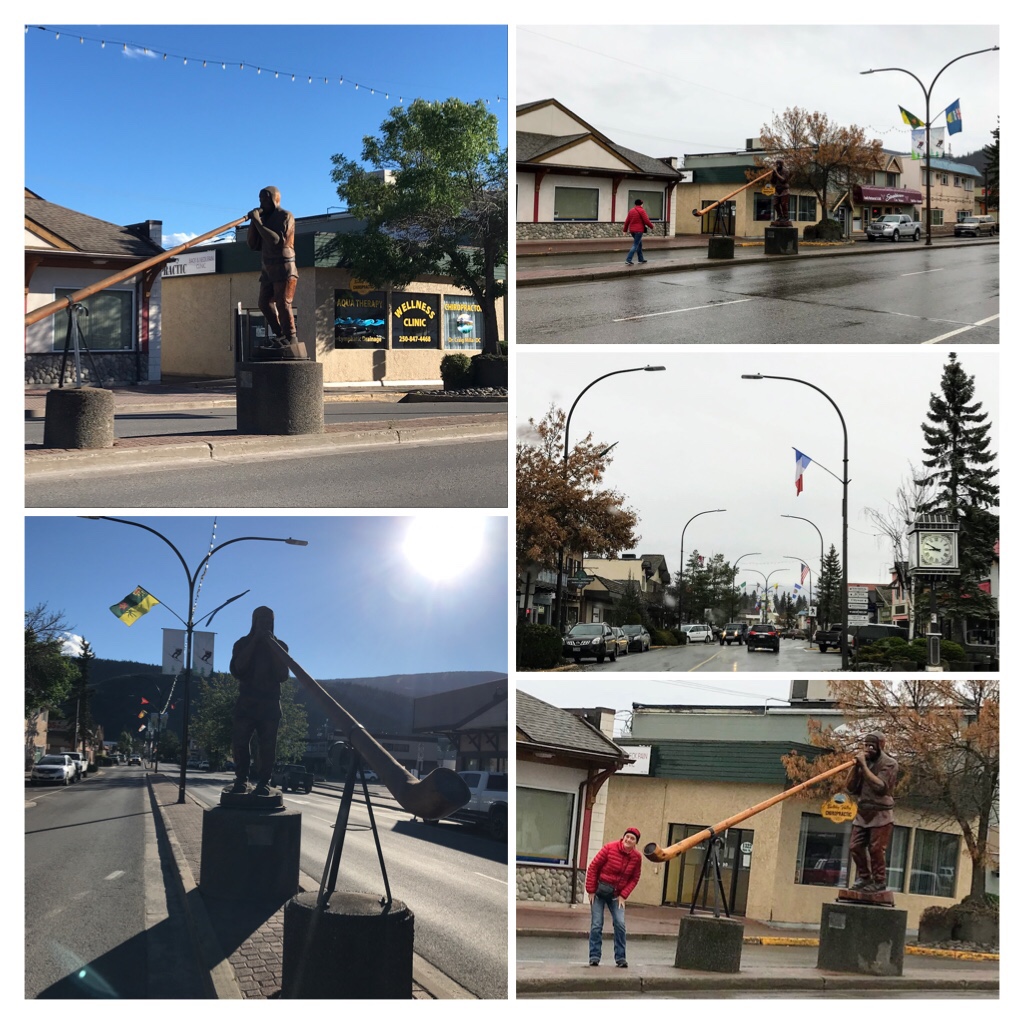
Smithers embraces parallels to the Swiss Alps from its much photographed Alphorn (also known as alpenhorn or alpine horn) to its Hudson Bay Mountain peak.
Smithers Alphorn in August and in March
The community prides itself on its “world class skiing and fishing” (particularly steelhead). We stayed at Smithers twice during the past few years. Once during March (before covid) and again in August 2021.
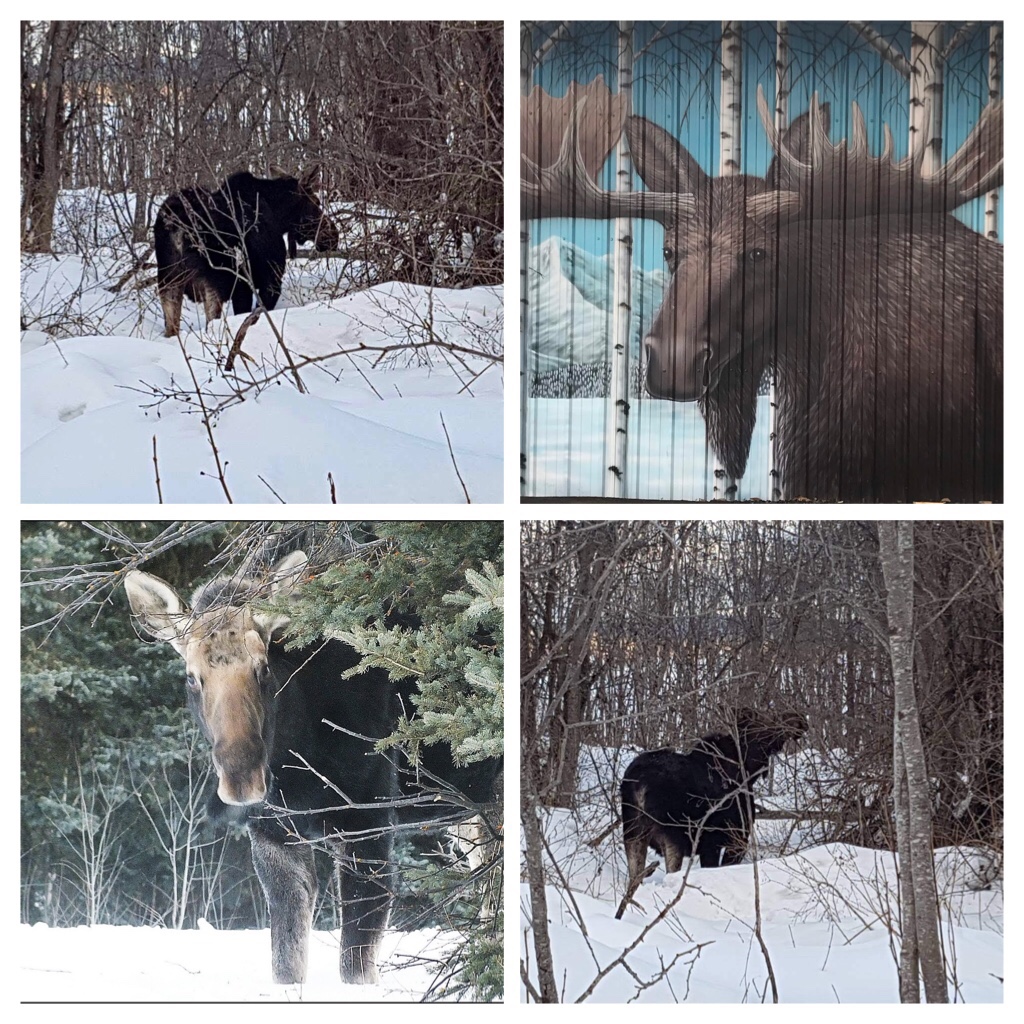
This video depicts our March 2019 (Spring skiing and Moose encountering) experience in Little Switzerland Smithers before Covid.
Stunning Smithers, skiing Hudson Bay Mountain, and “Oh! Hello?”
Despite its tiny population, Smithers has produced multiple NHL (National Hockey League) ice hockey players including: Joe and Jimmy Watson, Ron and Rob Flockhart, Alan Kerr, Dan Hamhuis and Michael Wall. Famous poets, musicians, authors, rowers, chefs, etc. also abound from this talented little town. For further information about Smithers, here is the local tourism link. http://tourismsmithers.com
Meanwhile…. Let’s check out some more Moose!!!!
Moose are generally pretty shy and not easy to locate… so we were incredibly grateful to experience these from a safe distance! The Moose mural was actually located at Prince Rupert.
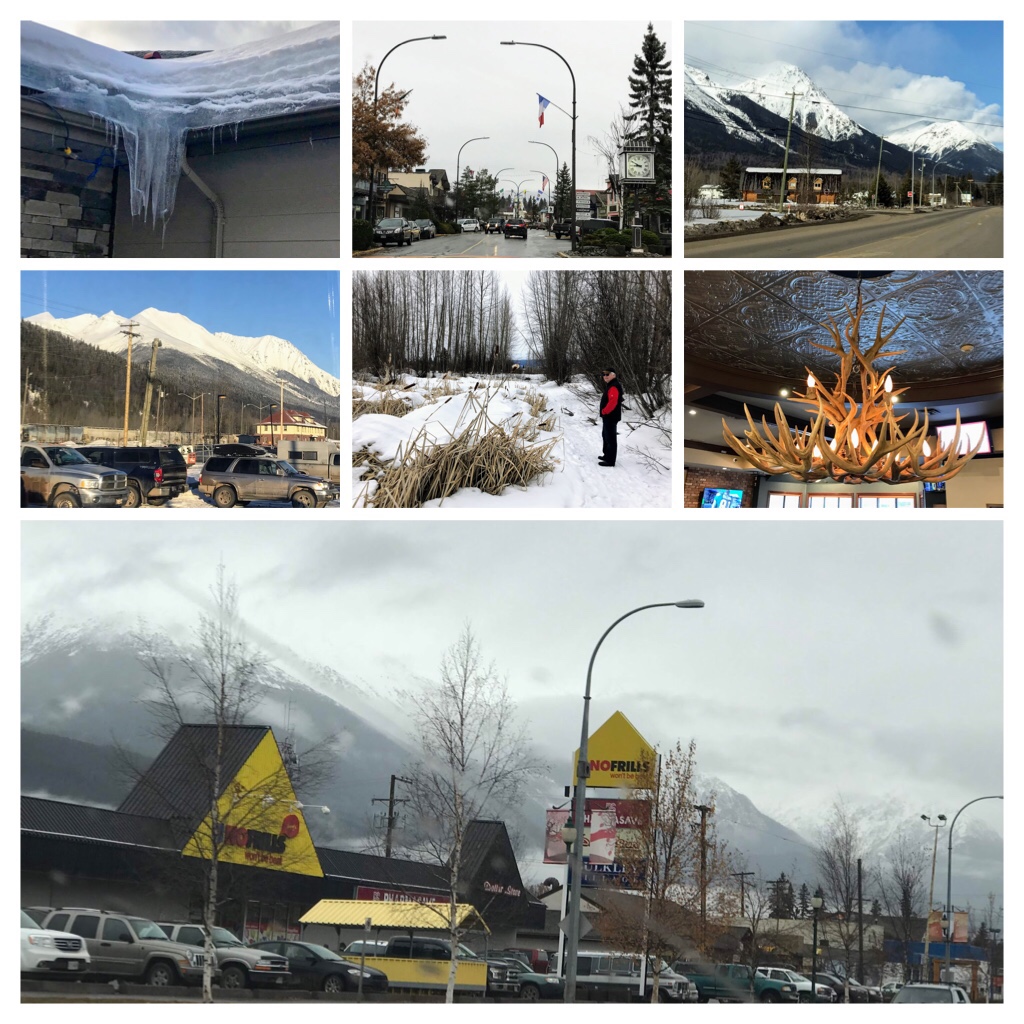
This collage illustrates some of the beautiful wintery conditions around Smithers during our March visit. The center photo is the marsh area where my husband encountered a moose while out on an evening stroll.
Winter conditions around Smithers in early March.
There are many natural attractions to explore around Smithers; such as, Hudson Bay Mountain, Moricetown Canyon, or Twin Falls. In addition, you can view the museum, art gallery, or brewery; or participate in a multitude of extreme sports.
When a member of your travel group has mobility issues, sometimes a driving tour is the most effective option. We tried to explore the main street of Smithers using a wheelchair, but many stores had raised doorways which were very hard to maneuver using a wheelchair. Hopefully, the town will improve access for wheelchairs in the near future. There were several funky boutique shops that looked really interesting, but sadly they were non accessible to those individuals using a wheelchair.
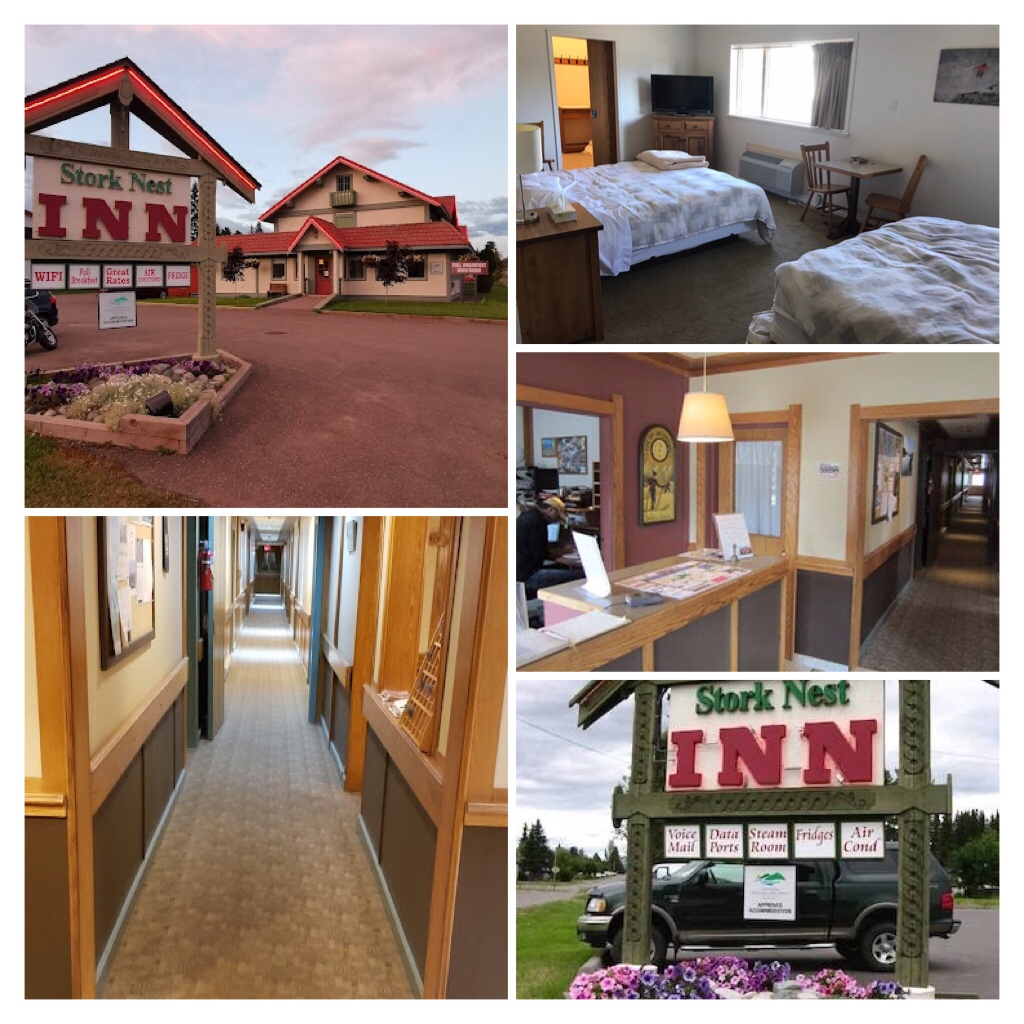
The Stork Inn has a wheel chair room! Finally!!!
However, there was 1 motel in the town which had a limited mobility room with a walk in/wheelchair shower! The family run Stork Nest Inn offers a quiet location with full breakfast, wifi, and 1 room that is suitable for physical mobility. Warning: it is located at the end of a lengthy hallway!
There are many choices of eateries in Smithers. Several locals all recommended Telly’s Grill on 4th Ave. We were so glad we heeded their advice because the Greek/Mediterranean cuisine was superb! We enjoyed the menu so much we returned 2 nights in a row!
Delicious meals at Telly’s Grill. Make a reservation! This eatery is popular!
The Alpenhorn Bistro & Bar on Main St. has unique décor especially the antler chandelier and the snow shoes/archives on the walls. If you feel like a lighter, healthy lunch or smoothie Two Sisters Cafe on 4th Ave. is well worth investigating!
Two sisters Cafe
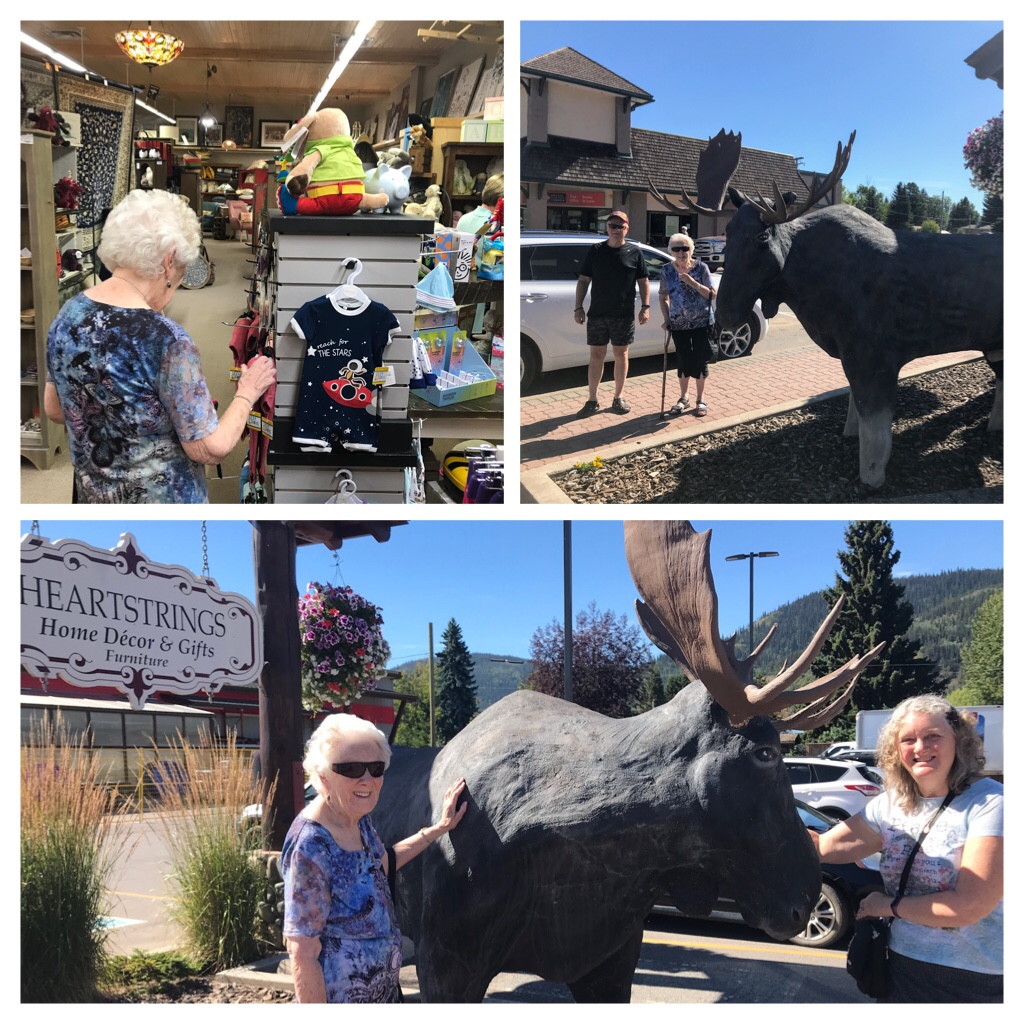
The one store that enticed mom to brave her cane and explore was Heartstrings Home Decor & Gifts! It truly is a diversified gem of amazing quality merchandise! No wonder nearly everyone we observed departed with teeming bags! It is easy to locate Heartstrings in Smithers. Just look for the Moose statue!
Heartstrings and the Smithers Moose statue!
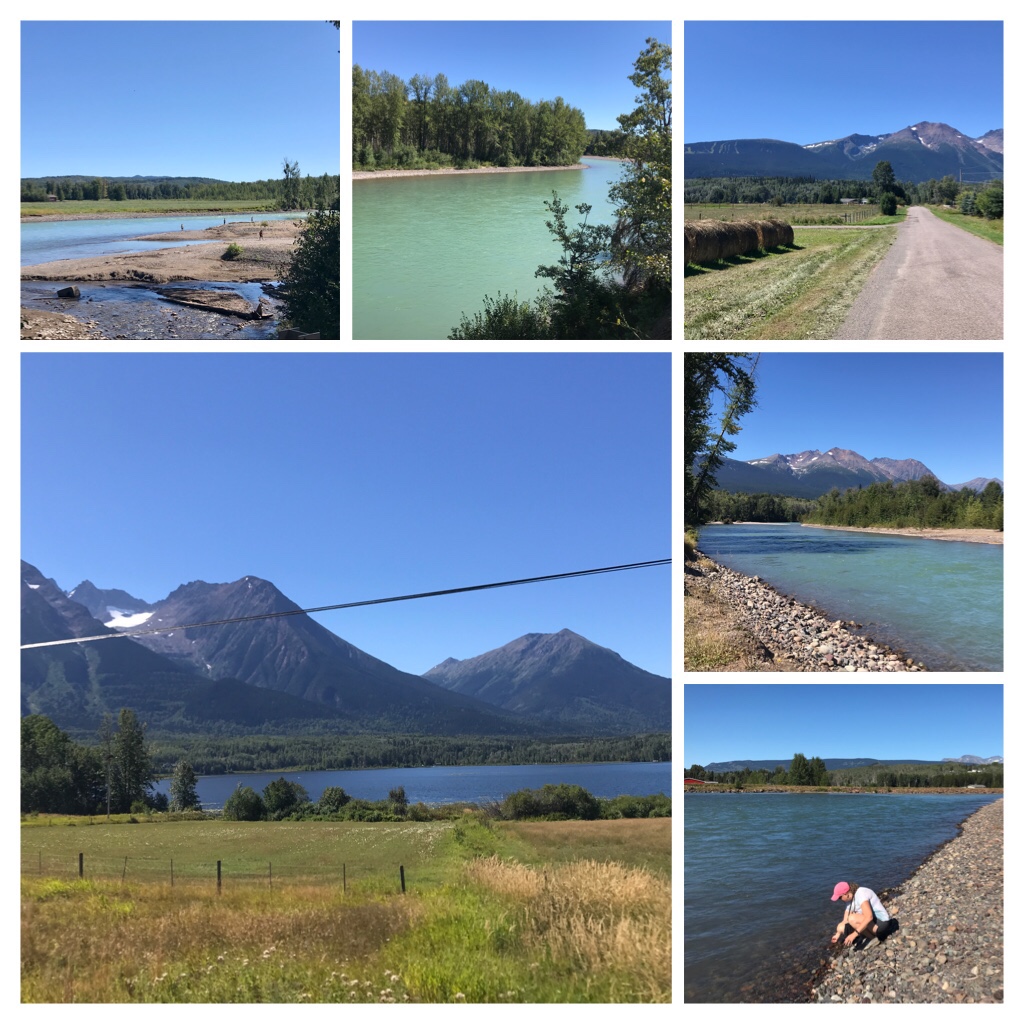
Driving around Smithers on a beautiful sunny day in August was peaceful and tranquil. There are so many pastoral fields and beautiful river spots to explore and appreciate.
Scenic Smithers!
Prior to departing eastbound on Highway 16 here is a short video highlighting some of our August 2021 experience in Smithers, B.C.
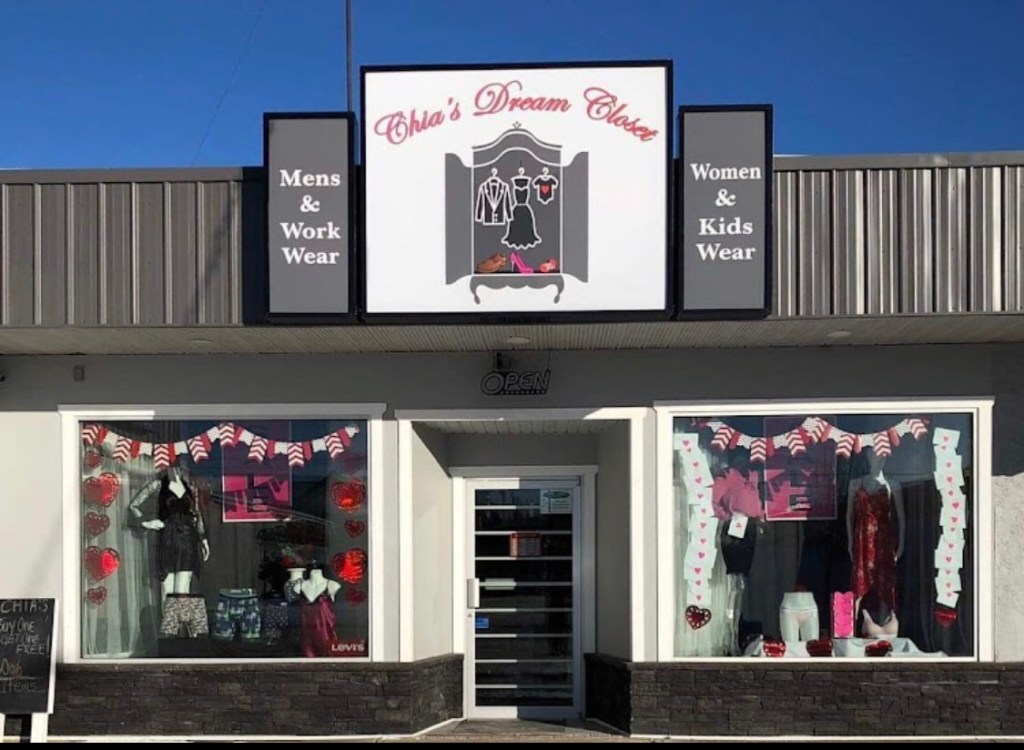
64 km southeast from Smithers is Houston, B.C. (Not Texas!). No visit to Houston is complete without checking the incredible stylish, affordable inventory at Chia’s Dream Closet.
Chia’s Dream Closet in Houston, B.C.
As expected, both mom and I departed with lovely new additions to our wardrobes. Ironically while researching about Chia’s Dream Closet, (for this blog post), I discovered a google reference to a previous post I had written about a trip to Houston in 2019. If you would like more information about this area, you can check this previous blog post too.
Beautiful friends shopping at Chias in 2019 (prior to Covid).
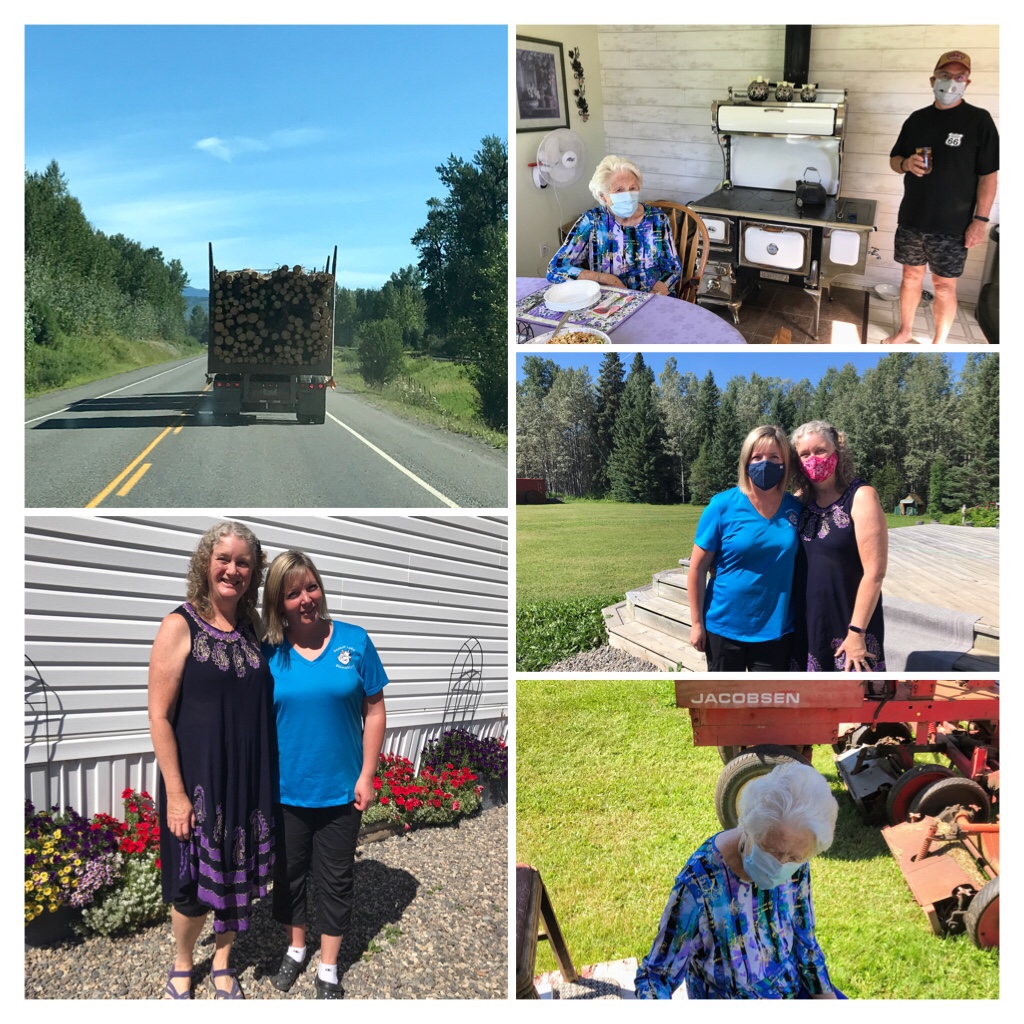
Returning to highway 16, we drove another 71 km past quiet Topley to Decker Lake area where we stopped in to say hello to a dear friend. Thanks for the lovely lunch Wendy.
Lunch break … Beautiful friends
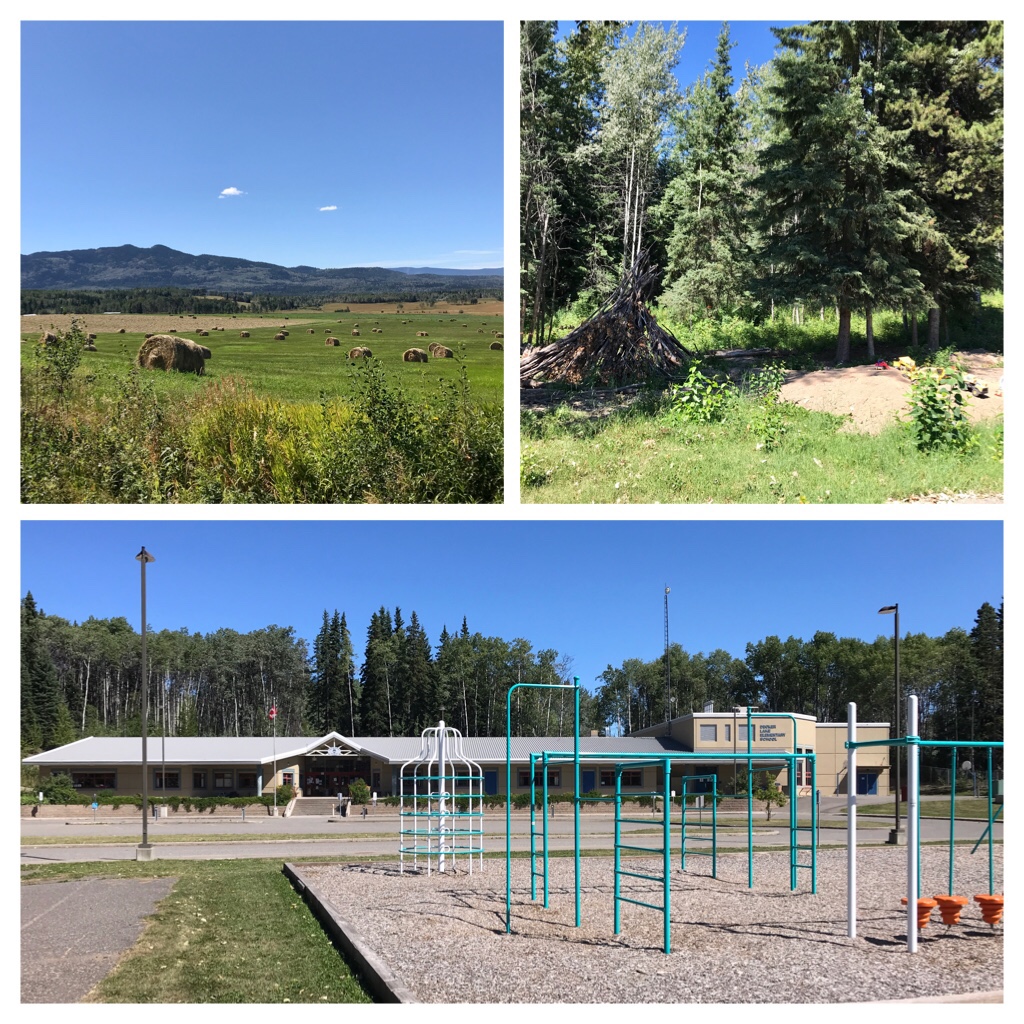
This is one of the two schools I taught at as Teacher-Librarian during the 2018-2019 school year. Ahhh memories at Decker Elementary School! I’m so, so grateful I retired before Covid 19 changed our world.
The students made the most incredible natural structures in the surrounding woods.
Ten minutes along hectic highway 16 and we entered the town of Burns Lake. When it’s -30 or colder in the winters and the snow and ice are piled over a metre high everywhere, this highway is brutal to drive!
The second school I taught at in Burns Lake was William Konkin Elementary. I lived in this home during the school year. (Photos taken in August!).
Beware of loaded logging trucks, huge semi trailers, massive oversized road and mine equipment, trucks, and a few cars on the road. Highway 16 is the major transportation linkconnecting the port of Prince Rupert (on the coast) to Prince George and Alberta. Did I mention the highway runs right through the downtown area?
Or… that the CN (Canadian National Railway) and VIA Rail train line also run parallel to the highway with phenomenally lengthy trailers multiple times a day? Train safety is taught at schools in this area as trains sometimes pass every hour! I contemplated taking a train trip from Burns Lake to Prince George during my year up north, but never was able to discover a depot location? Burns Lake is one hectic and very busy transportation junction!
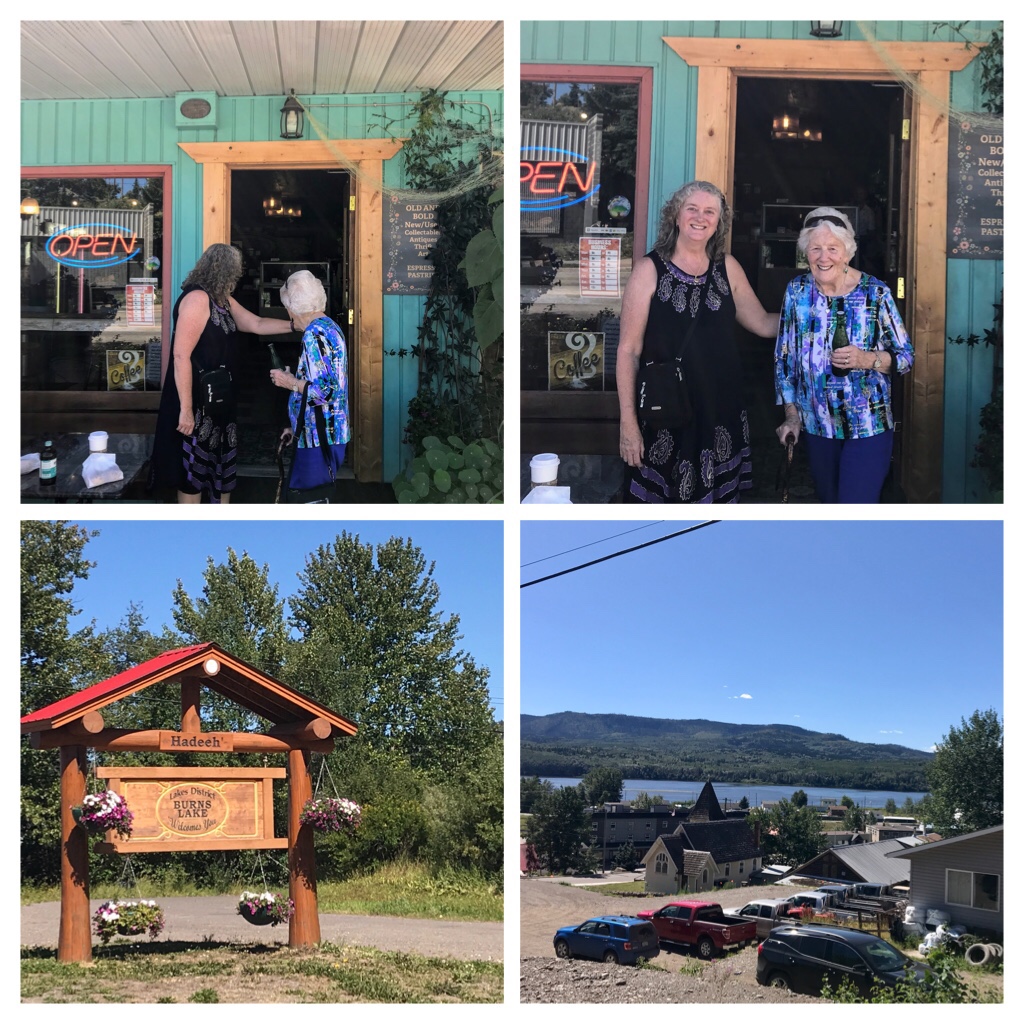
Burns Lake. Pick up wonderful coffee and incredible European baking at the Old and Bold Espresso Bar.
As we were passing through Burns Lake en route to Prince George, we only had time for a quick tour of some of my favorite locations around this hub village of about 2,000 people. I have written multiple posts about this area during my year teaching up north. Please use the search feature in my blog to obtain extensive additional information and photos of the beautiful Burns Lake area.
One of my favorite locations directly off highway 16 in downtown Burns Lake is the Old and Bold Espresso Bar. Say hello to Mattias for me! He’s such a delightful man whose jubilance fills his Backerei with warmth and curiosity. Plus he bakes amazing European breads and desserts!
Mattias serving in his Old and Bold Espresso Bar (prior time covid)
The inside of Old and Bold Espresso Bar has been adjusted according to covid restrictions, but the lattes and baking remain incredible!
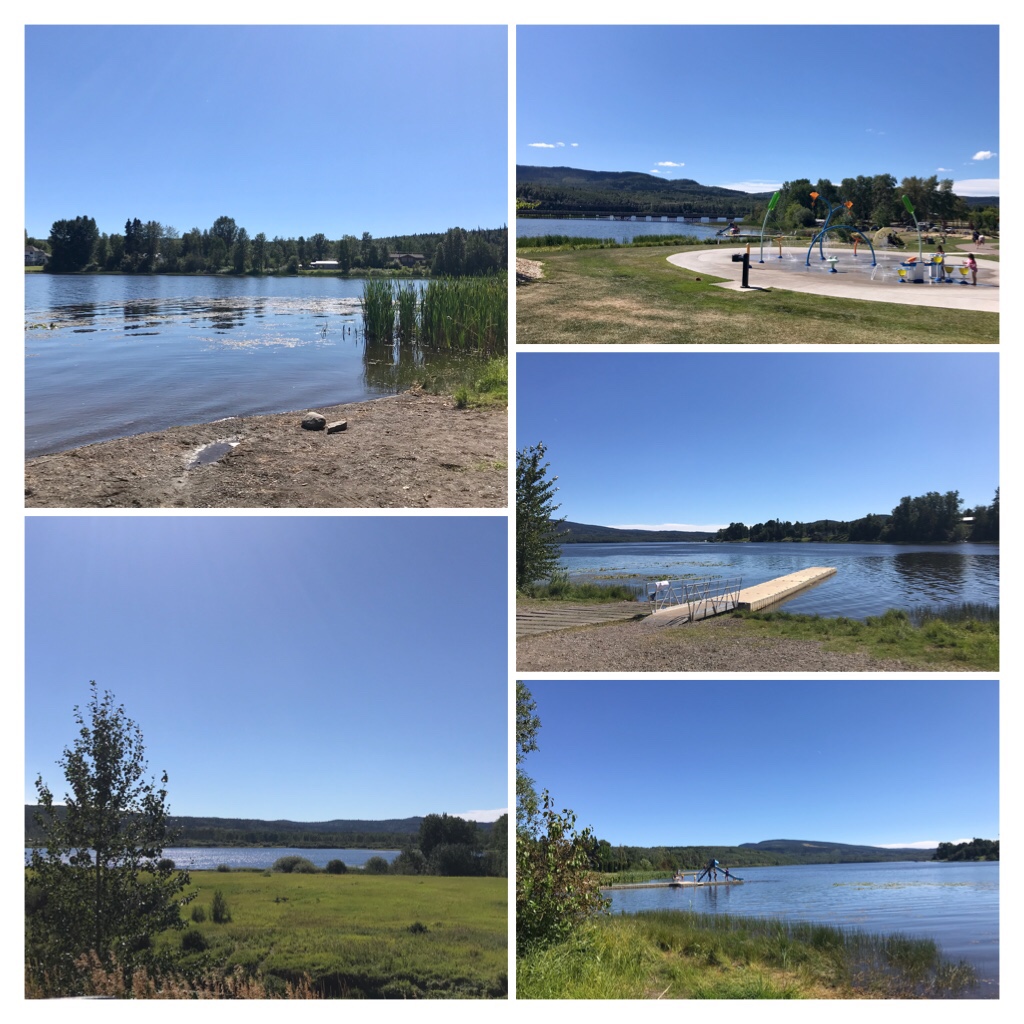
We drove down to the Lakeside Multiplex area and had a quick view of Burns Lake, the camping area, Spirit Park, skateboard park, tennis courts, and new water park.
Burns Lake from Spirit Park August 2021
Continuing along Highway 16E meandering around Nechako Lakes we drove the final 227 km to our destination of Prince George, British Columbia. This section took about 2 1/2 hours to drive passing by the communities of Fraser Lake and Fort Fraser.
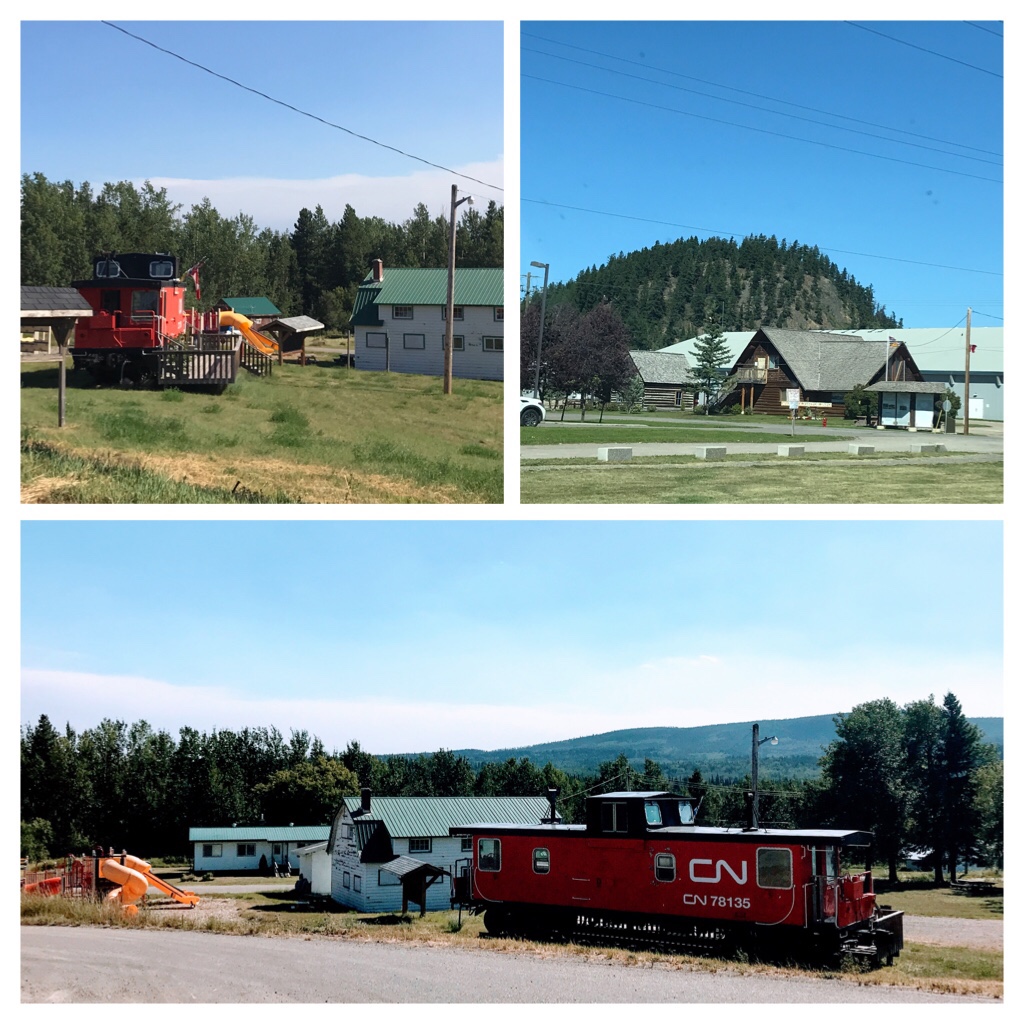
Mouse mountain at Fraser Lake. The CN train park at Fort Fraser.
I always planned to hike tiny Mouse Mountain! Oh well… I guess I’ll need to add that to my list for our next trip up north!
Continuing east on highway 16, as we neared Vanderhoof evidence of wildfire smoke started to stain the skies.
Highway 16 from Vanderhoof to Prince George! Wildfire smoke!
We were all grateful to spot the Prince George iconic statue of Mr PG. Time to relax. It was a lengthy day of travel for mom!
Returning home would be an adventure due to highway closures (wildfires, mudslides). The next blog posts will highlight our return adventure through British Columbia from Prince George back to Vancouver Island.
This blog post is a collage of life events and activities, and Canadian Flora and Fauna, during April (Springtime). From kayaking and wildlife (Beavers, Bears, Elk) to Spring flowers and blossoms on our beautiful Vancouver Island. To round it out, there are a few antics from our 11 month old kitten Sophia and a few Covid Sanity Strategies.
2 week quarantine time for my husband after returning home from working in Ontario.
April 2020 commenced with my husband quarantined in our cabana and the backyard for the first 2 weeks. He had flown home to Nanaimo, B.C. from Toronto, Ontario. It was a peculiar life experience to be physically separated and distanced during the quarantine juration and wear masks and gloves while I delivered and removed food, etc. But….We were successful and healthy, and now have new stories to share about Covid Adaptations.
Meanwhile, Sophia (our 11 month old rescue kitten) and I snuggled and awaited the end of Mark’s two week quarantine.
Sophia our rescue kitten aged 11 months…has learned to snuggle.
Sophia still suffers from anxiety and likes to tunnel or hide under mats, pillows, or blankets to feel more secure when she is frightened. However, she now realizes she gets attention from this behavior and often makes the hiding into a game. I call this one her “turtle” game.
Sophia’s turtle hiding game.
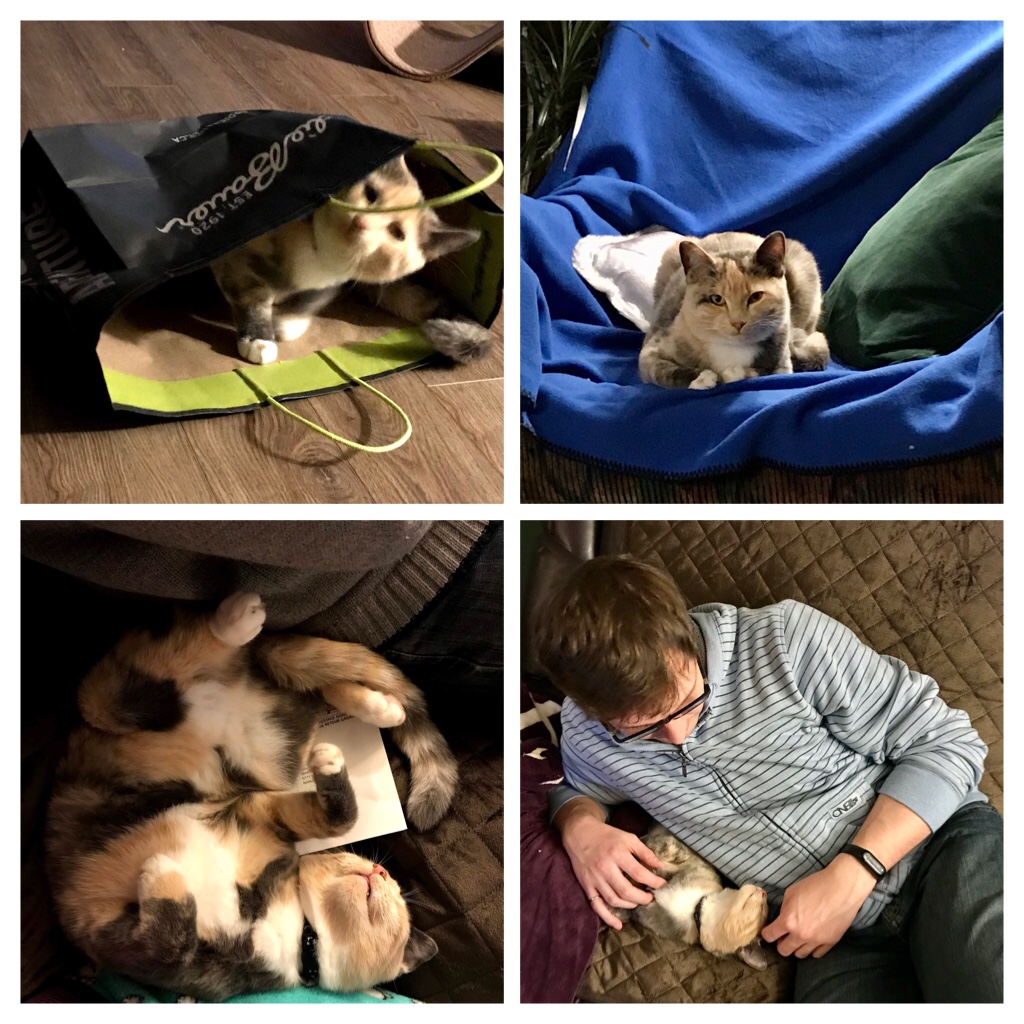
Sometimes, she is just plan curious! She likes to explore anything new from all angles!
Sophia exploring a new collapsible step.
Finally, Mark’s quarantine period concluded, and it was time to venture out together and ‘safely’ explore our “Covid lockdown health region” on Vancouver Island.
Mark and Sandy outside together–April 2020
My son, Alexander, is an Engineer working in Victoria. Due to Covid rules and restrictions, the construction completion of his new apartment was delayed. We assisted (from 2m) by renting a UHaul and bringing his belongings down to Victoria when he finally obtained the keys–April 15th–which also happened to be his birthday!
Alexander’s new digs in Victoria
Spring is a stunning time of the year embracing new growth and reemergence of wildlife after winter hibernation. It is also pollen season. Locate your nearest local honey producer and consume lots of local honey to increase your pollen resistance! It works!
The Crocuses, Daffodils, Tulips, Primroses, Snowdrops, and Heather are some of the early flowers to come into bloom here. The Dogwood, Azaleas, Rhododendrons, Cherry and Apple trees, and a multitude of species are popping blossoms sharing an abundance of delectable hues and scents.
April flowers and blossoms galore!
Spring is also a wonderful time to observe and possibly encounter some of the beautiful wildlife on Vancouver Island. The Columbia Black-tailed deer are the deer species located on our island. The life cycle of a Blacktail is 9-10 years in the wild, but only 3-6 years for bucks as they are the target of hunters each fall.
Due to increased Forestry clear-cuts and growing urban areas, these deer are now common in many residential areas. We observe a family visiting our yard to graze nearly every day, so deer resistance plant species, like Forest Flame bushes, Rhododendrons, Heather, and Daffodils are good plants for your gardens.
Out of approximately 3,200 Roosevelt Elk in the Province of British Columbia, roughly 3,000 Roosevelt Elk reside on Vancouver Island. They are quite massive animals and often seen in herds. Approximately 20 elk tags are given out each hunting season. Beyond that, our beautiful creatures are respected and revered. The toll free number if you witness any illegal activity effecting our wildlife is 1-877-952-7277.
Roosevelt Elk herds are majestic creatures.
Black bears are also spotted around the island, especially when they are eating spring shoots or scavenging on rocky beaches to fatten up after their light hibernation period. Estimates indicate there are about 7,000 black bears on Vancouver Island. In the spring sows over aged 5 years are usually seen with 1-4 cubs. Three or four cubs are quite rare, twins are the most common.
Although Grizzly Bears were unheard of on Vancouver Island a few decades ago, there have been a few sightings in recent years. It is suspected that some Grizzlies were successful swimming across from the mainland by island hopping en route. There are many talented professional wildlife photographers on Vancouver Island and tours to view our beautiful wildlife are available. Remember, if you see any illegal hunting please phone the toll free line to protect our wildlife from poachers!
The third Canadian animal I am sharing this post is our national symbol of Canada–the Beaver! The Beaver is the symbol on our 5 centcoin and was once nearly eradicated during the Fur Trade era. They are making a come back and although these photos were taken by a friend in northern B.C. (notice the snow), we have Beavers thriving here too usually hiding out in small lakes or marshy ponds. Watch for the chewed tree trunks, piles of small fallen trees, lodges and dams.
The Canadian Beaver…Famous for its amazing flat tail. These photos were from northern B.C.
Our rescue kitten was discovered in the woods too…but her habitat and survival is slightly different from the elk, bears, and beavers!
It’s a tough life for Sophia! lol
The final topic in this blog about April, is Covid Survival Strategies:
Appreciating your neighborhood. Working in your yard. Observing nature and being grateful for what you have. We were so grateful that the Fire Department efficiently and effectively put out the chimney fire for our neighbors.
Fire Department was quick to solve this problem across the street.
2) Dr. Bonnie Henry establishing Covid Safety rules and protocols for the province of British Columbia to help us flatten the curve and keep safer.
Covid physical distancing, rules and protocols. April 2020
3) Learning New Skills and Adapting to Change. After much coercion from my husband, I started cutting his hair! We found that meditation and yoga each morning really helped bring a calmer, healthier perspective to each new day.
Adapting to change during Covid.
4) Using extra lockdown time to sort, organize and downsizeor share. We saved money taking the last of our belongings out of our rented storage locker and seriously analyzed whether we really needed these belongings. We discovered some treasures we had forgotten about, some items ready for recycling or garbage, and I gave away boxes of free educational resources to new upcoming teachers.
Getting outdoors to kayak around Nanaimo area.
5) Our final Covid Strategy is get outdoors and experience nature while exercising! Often, this can be walking, hiking, riding your bike, or playing; but in this post I will feature going kayaking in the Pacific Ocean!
Here is a short video of some highlights from 2 consecutive days of kayaking around the gorgeous Pacific ocean surrounding Vancouver Island. We did not see whales or sea lions on these excursions, but seals and river otters are quite common companions.
Video of kayaking around Nanaimo
Thank you for joining my journey throughout the month of April. The next blog post will include more trips and adventures exploring hiking trails, beaches, and natural beauty around Vancouver Island during May. Also, Sophia turns 1 year old!
Keep Safe. The world continues to brighten each week.
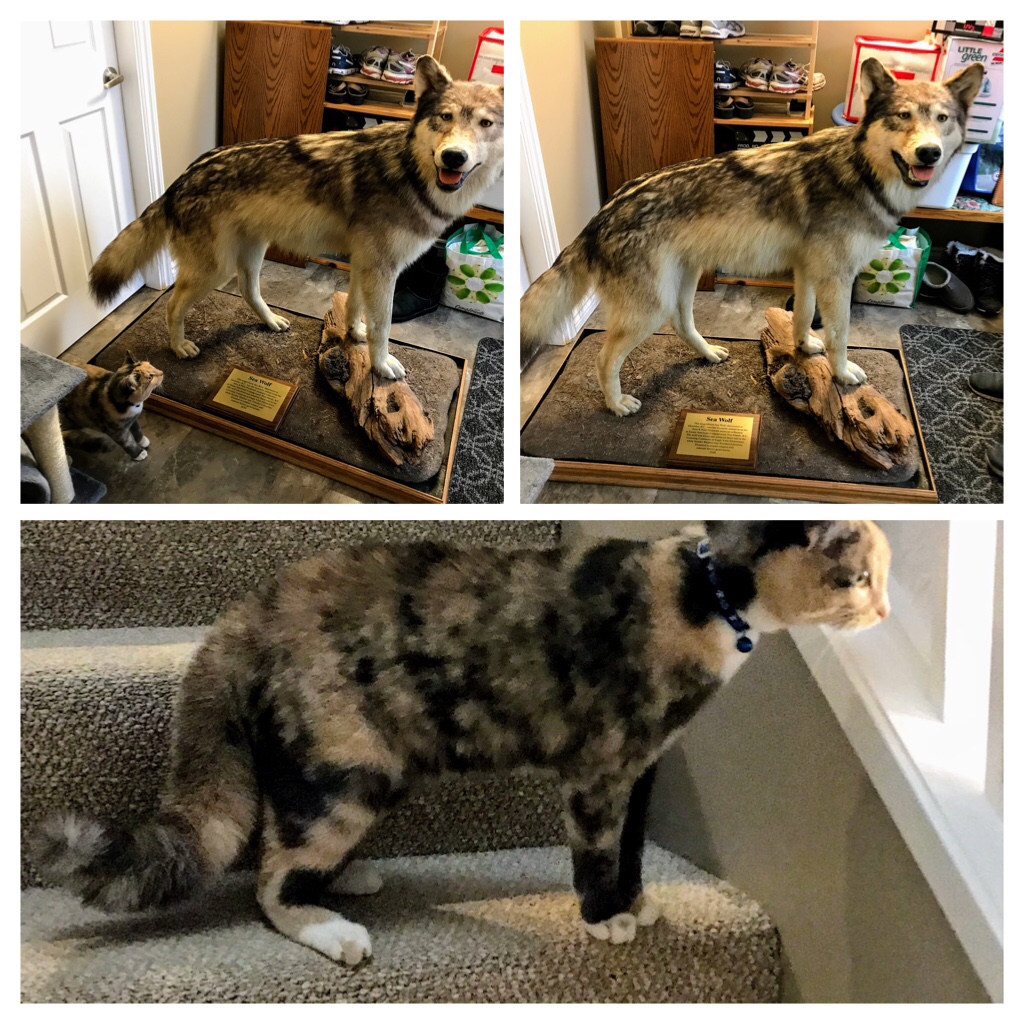
Sophia is our adventurous Rescue Kitten. Her litter was discovered in the forest and veterinarians estimate she is about 8 months of age. This post reflects our adventures on Vancouver Island, B.C. Canada and our kitten’s reaction to seeing the magnificent wolf which our family was donating to an Educational and Recovery Wildlife Facility near us.
These photos reflect a legacy of learning from our local wildlife. No animals were hunted… all died through accidental or natural causes and were lovingly part of my father’s museum collection.
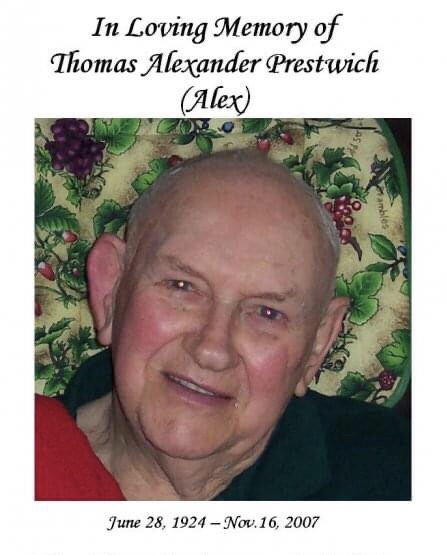
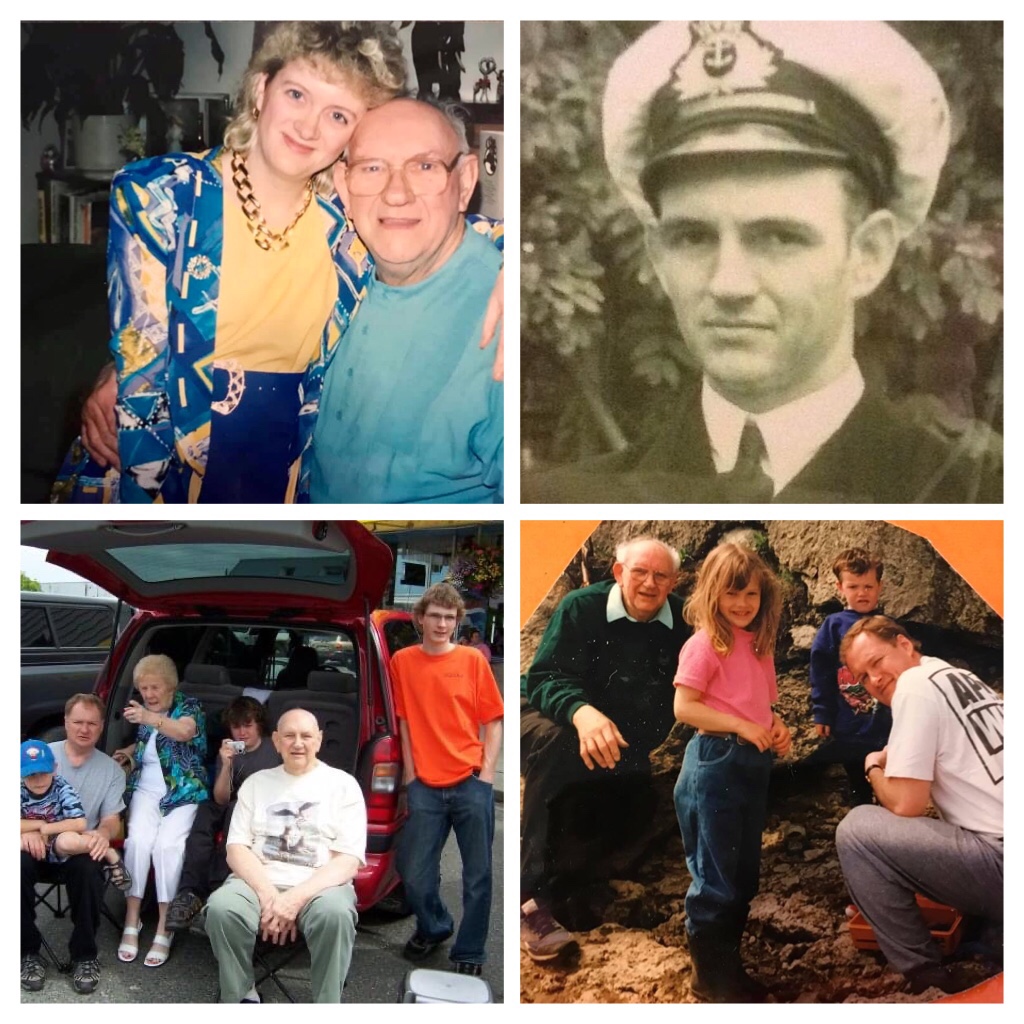
My dad, Alex Prestwich, passed away in 2007 after a lengthy battle with a major stroke, blindness, and cancer. He adored and deeply respected the wildlife on Vancouver Island and treasured each living animal.
Dad even had a raven that frequently hung out on top of a massive press inside his machine shop. Black bears, deer, and the odd cougar also came by to visit when he worked late at night.
Dad was passionate about learning and inspired so many children with his constant curiosity towards life. It was these traits that eventually spear headed decades’ long development of a wildlife taxidermy collection to inspire and educate others.
Loving memories of my dad Thomas Alexander Prestwich
No animals or birds were killed or hunted. All animals died through accidental or natural causes, then were assessed by the conservation officer, prior to their release to my dad. All taxidermy was completed on Vancouver Island and dad would only allow the animals to be portrayed in natural and respectful poses.
Cougars and Wolf
When dad passed away, we knew the Canadian wildlife collection needed to find the perfect home where people would continue to love and respect the animals and environmental education would continue to be emphasized.
After substantial searching, we knew we discovered the perfect new location when we arrived at the North Island Wildlife Recovery Center in Errington.
In addition to the educational areas filled with taxidermy and media presentations; the extensive grounds were a collage of native flora gardens, ponds, and areas where black bear cubs, eagles, and injured or abandoned wildlife could heal and survive.
This non-profit organization is mainly run by volunteers who all love and care about nature and our amazing wildlife. Robin and his wife are passionate leaders who have made such a positive difference in our world. Dad would have adored touring or volunteering at this amazing facility.
The organization is on social media.
On our initial trip to NIWRC we presented the entire collection (for Educational Purposes) except dad’s favorite animal, which was the Wolf.
It is painful to say good-bye to special items when you loose a loved one. But it was time to let go and share this magnificent and rare animal with the world.
Sophia knew something was up and crept hesitantly downstairs to investigate. Her tail fur totally puffed up when she spotted the wolf waiting to be transported to the NIWRC. Curiosity won and she hesitantly approached the wolf.
Sophia meets the Wolf
Ironically, the coloration of the two mammals was so similar. However, within minutes she raced back upstairs then watched from the safety of the door as the wolf was carefully transported into the truck.
Here is a short video of Sophia and the Wolf as we donate this magnificent animal to the North Island Wildlife Recovery Center.
The legacy and future of this magnificent Wolf. May it inspire curiosity, respect, and understanding.
Although much of our family lives in varying areas of Canada, we had 3 generations represented when we donated the Wolf to its new owners/educators. Thankfully this occurred just prior to covid restrictions, so masks were unnecessary for this event.
3 generations of our Prestwich family with Robin (owner) at the drop off location.
My 88 year old Mom, (Patti) was so thrilled to see the family collection on display as Robin (owner) gave us a grand tour of the grounds and educational facilities. My son, Alexander, represented the young adult generation. I represented the middle of the trio.
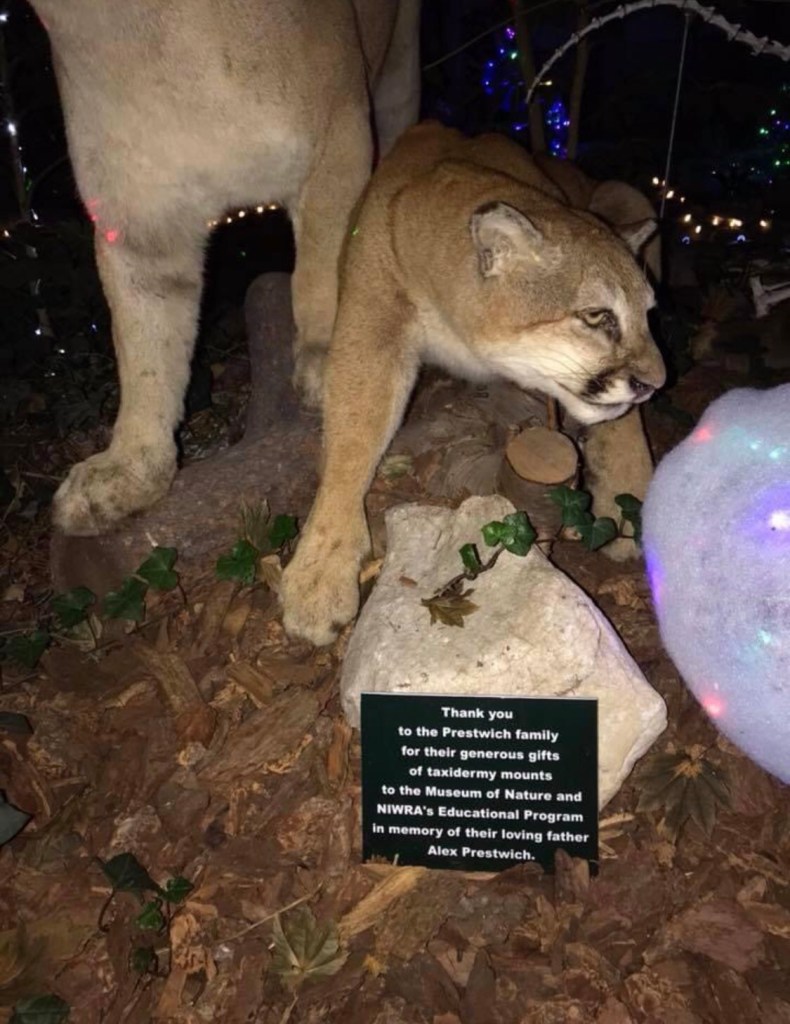
Thanks for the Beautiful sign at North island wildlife recovery center.
If you are touring through Vancouver Island and enjoy wildlife recovery and learning about Canadian wildlife, this is a amazing facility to explore. Bus loads of curious school children frequented here prior to covid lockdown and will return again soon I am sure!
When we returned home, Sophia made sure we knew it was her turn for attention once again.
Our Sophia letting us know it’s her turn for attention again!
Keep safe and optimistic 😉. The next posts will be adventures around Vancouver Island and skiing at Mt Washington!
Reflections of December 2019. Our life was so free and hugs were plentiful. Family and friends could gather and interact without masks or 2 meter distancing. This blog post is dedicated to memories of that time and optimistic hope and appreciation for our future …
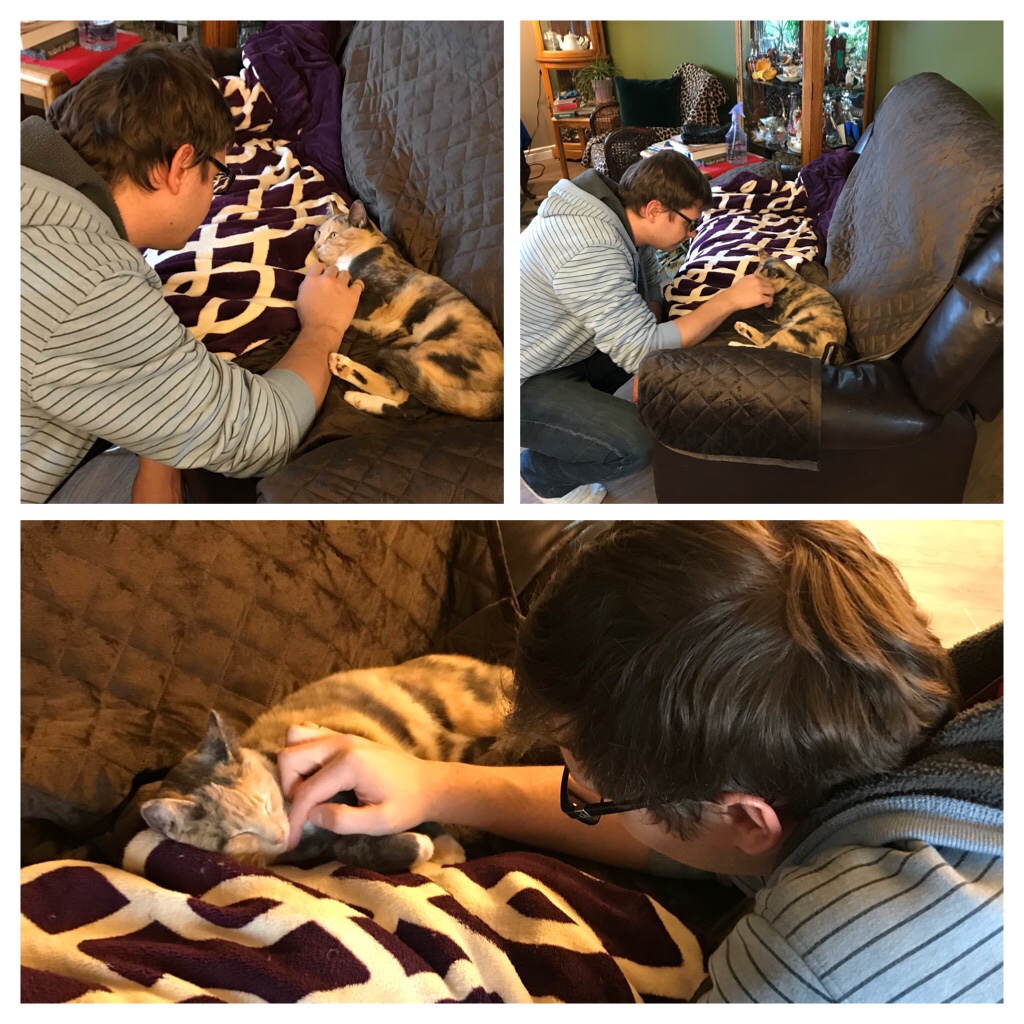
Our Rescue kitten Sophia learning to trust and love— especially Alexander’s touch.
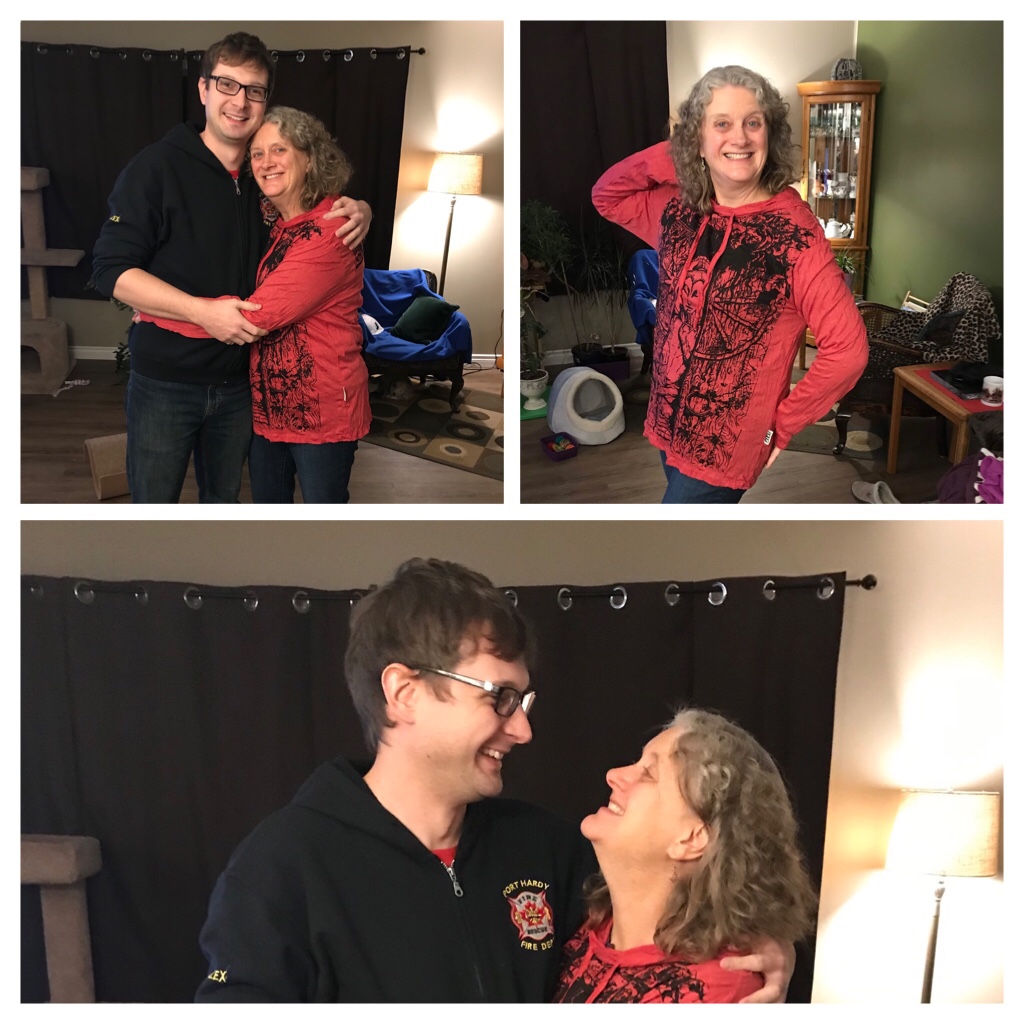
My son Alexander, and our rescue kitten Sophia, truly bonded while my husband and I were relaxing and exploring around Playa del Carmen, Mexico. I’m so thankful that Alexander decided to return home to Canada prior to the global pandemic after living/working in Bangkok for 6 years as a senior Design Engineer at Western Digital. There is something magical about mother/son reunion hugs!
My son and I (modelling his birthday gift from Thailand).
I am retired after spending 35 years educating students. My husband, Mark, is semi retired. Yet, we are always busy learning and exploring new ideas or commencing new projects. One of our most time consuming projects is home renovation!
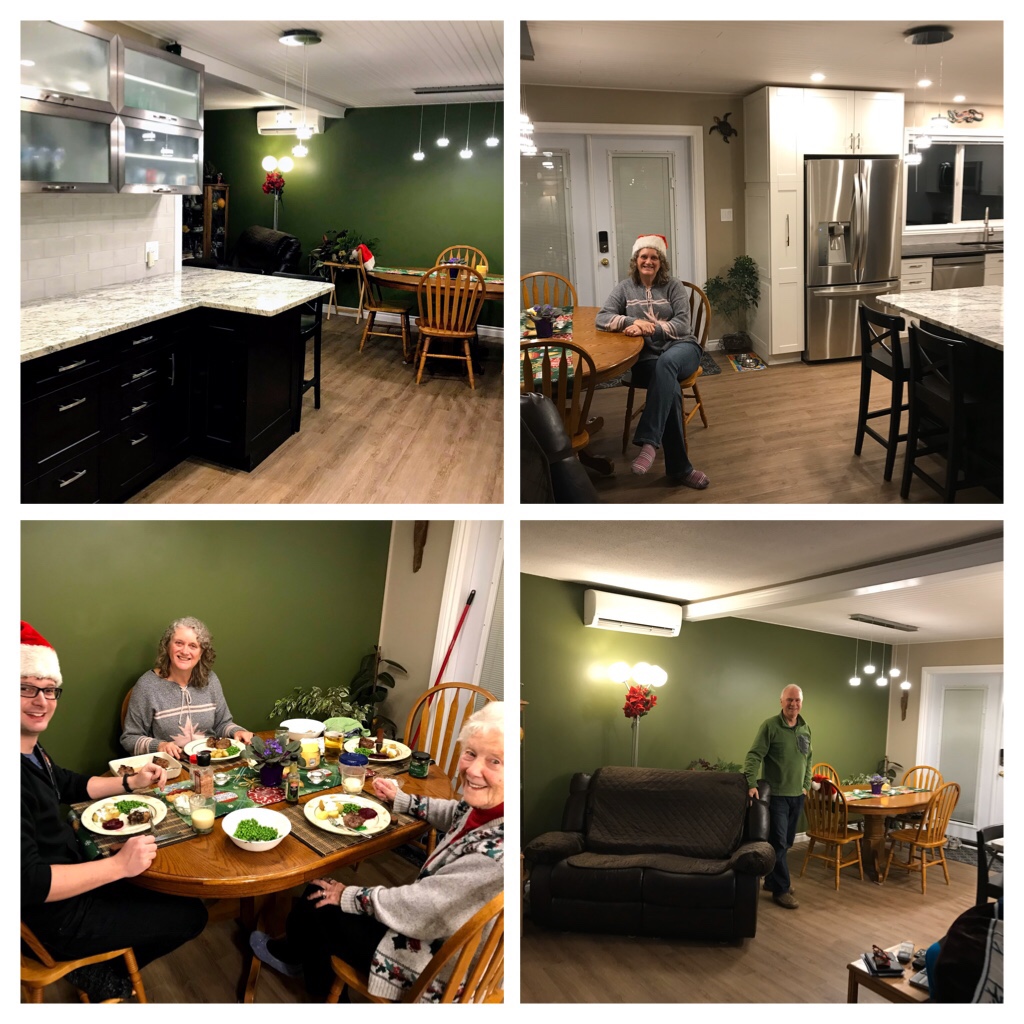
Our newly updated kitchen and living area space is such an improvement on the previous version. Although my talented husband completed the majority of the renovations, it was lovely to sit back and have our backsplash completed by a tiling specialist just before Christmas!
Installing kitchen backsplash tiles!
Next…. we removed the protective plastic off the stainless steel appliances! It’s tougher than it looks lol
Exposing the stainless steel
While kitchen renovations kept us occupied indoors, what was happening outdoors near our home?
The Canadian animals on Vancouver Island are busy in the autumn and early winter. Black tailed deer are regular visitors around our yards consuming lots of leaves and plant life while their coats thicken in preparation for upcoming colder temperatures and snow.
Black tailed fawn with winter coat
We have reached a truce with the deer…The backyard is off limits and “deer fenced” to protect our flowers, vegetables, and shrubs. The front yard is open ‘game’ to our nibbly, cute visitors. Does and fawns regularly visit, but bucks are less common in the residential areas. Sophia is fascinated by the deer and often watches or sometimes approaches the fawns as they feed.
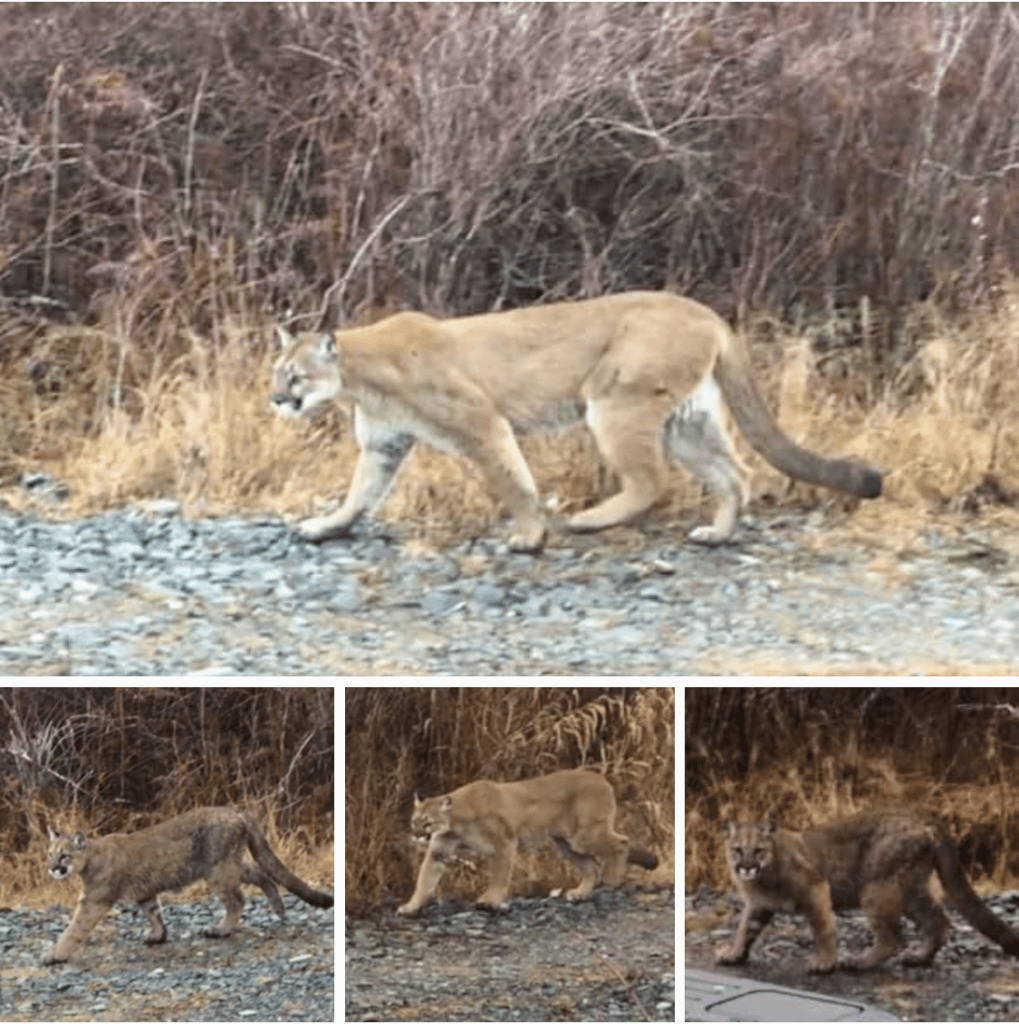
Deer and raccoons are common here. Beavers, elk, and black bears are viewed occasionally if you are lucky. But when the cougars come out of the forests and roam freely, we are fascinated–yet greatly concerned.
Cougar with 3 kits on Vancouver Island–December 2019
Cougar attacks on people are rare, but can occur if nature’s balance is upset, or a cougar is sick or starving. This cougar (with 3 kits) was photographed by a friend in a nearby community in December.
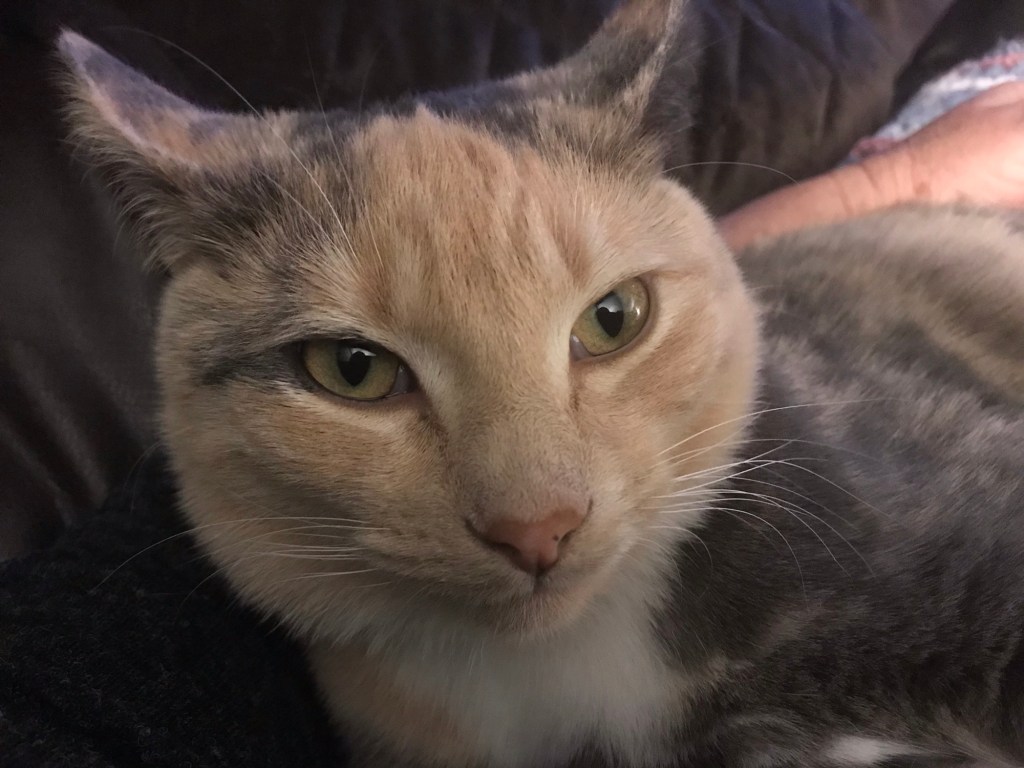
How does our rescue kitten, Sophia, react to all the action inside and outdoors? With definite mixed emotion….
I’ll just be cute and allow Alexander to stroke me…
That’s enough! Time to climb some trees and chase some deer!
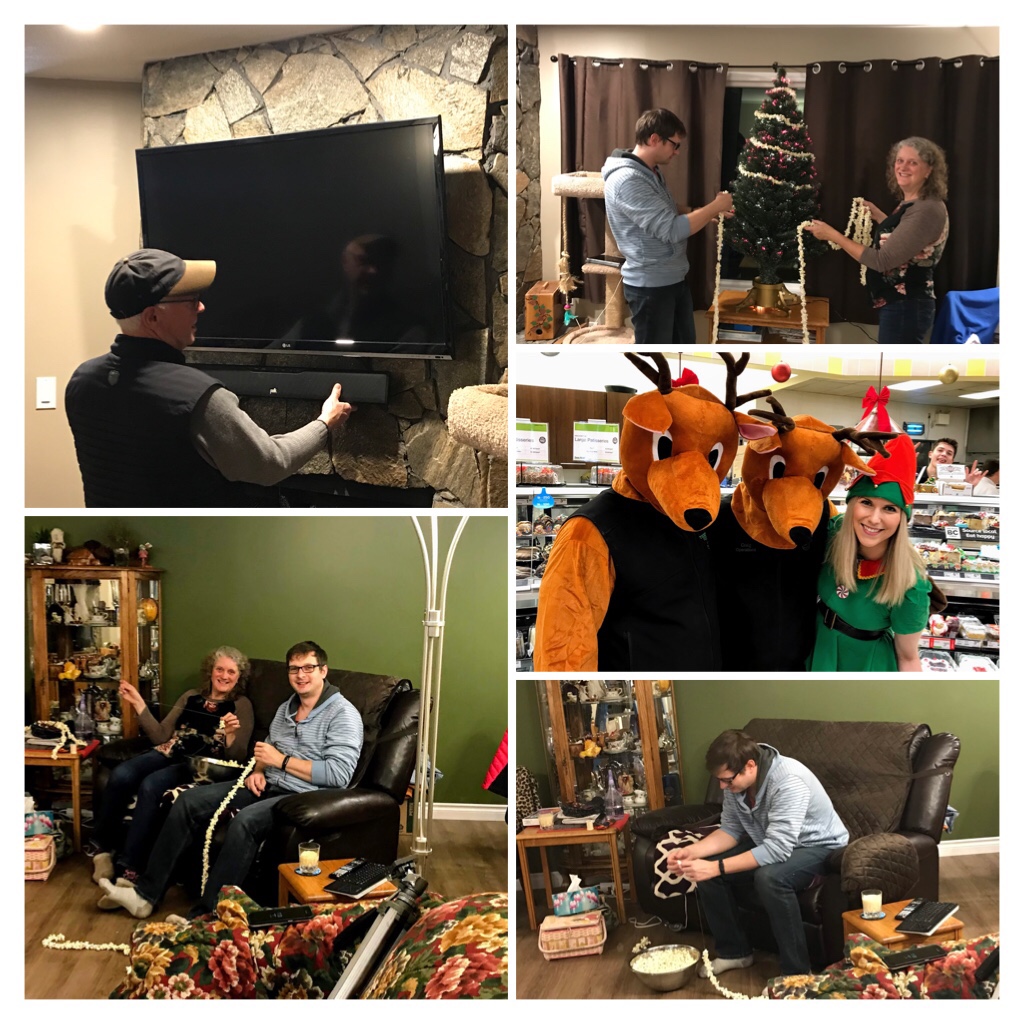
Next, it’s time to string popcorn, decorate the tree together while listening to festive music and drinking eggnog, and enjoy the festivities leading up to Christmas.
December events
Time to enjoy family (mom is arriving soon) and good friends. Our art isn’t up yet on the walls, but we are so excited to socialize with those we care deeply about.
We’re ready!
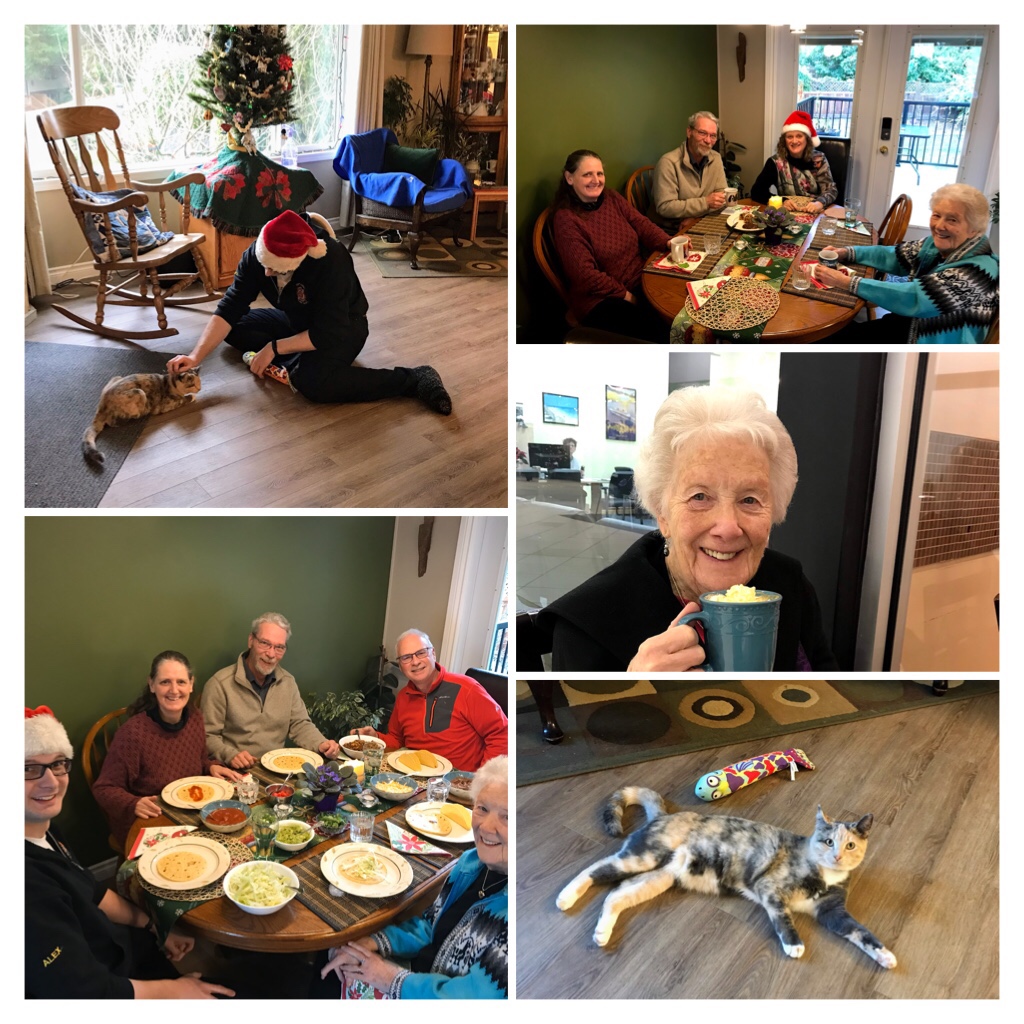
How lovely it was to socialize with friends we haven’t been able to visit now for nearly 1 1/2 years. How grateful we will feel when once again we can share meals together in our homes.
Even Sophia approves!
This blog post was a mixture of memories and events from December 2019. The next post will be memories and fun from the last festive season before the global pandemic. Stay tuned. It’s coming soon!